Thread Choices for Machine Embroidery: A Complete Guide for Returning and Beginner Embroiderers
Thread Choices for Machine Embroidery: A Complete Guide for Returning and Beginner Embroiderers
Introduction
A Reddit user recently posted a question that resonates with many returning to the craft: “I am just getting back into sewing and machine embroidery after 20 years or more. I cleaned out my stash and threw away all of my old Sulky thread since it was dry rotted. What thread type and brands are popular now?”
If you're in a similar situation—returning to embroidery after years away, or just starting out—this guide will walk you through everything that's changed, what's still true, and how to choose the right thread for your machine and your projects.
1. Why Does Thread Choice Matter More Than You Think?
Thread is one of the least costly inputs for embroidery, but it directly determines stitch appearance, machine performance, and the durability of your finished product. Poor-quality thread can lead to thread breaks, slow sew speeds, lint build-up, and tension problems that require additional maintenance time. As one industry expert puts it: “My sanity is worth more than cents on the dollar, and yours should be too.”
Key point: Thread quality affects everything from how smoothly your machine runs to how your finished embroidery looks after repeated washing. Choosing the right thread is not an area to pinch pennies.
2. What Thread Types Are Used in Machine Embroidery Today?
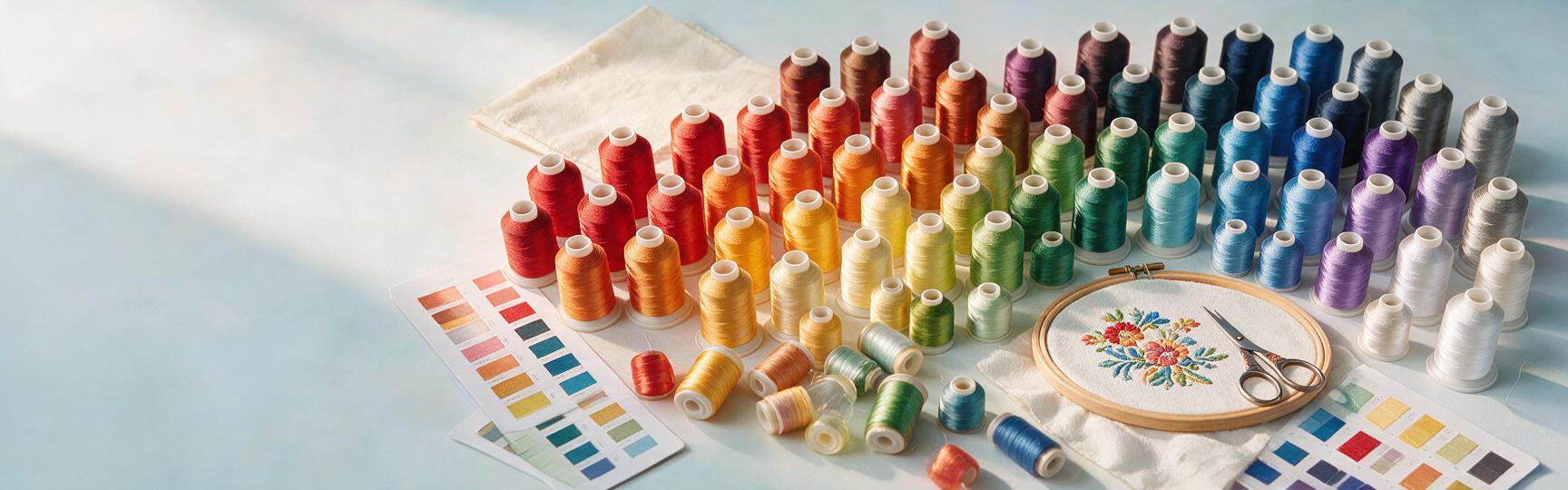
There are four main thread types used in machine embroidery today. Understanding their properties helps you match thread to project:
| Thread Type | Best For | Key Characteristics |
|---|---|---|
| Polyester | Uniforms, workwear, outdoor items, frequently washed garments | Superior tensile strength, colorfast, UV resistant, bleach resistant |
| Rayon | Fashion garments, decorative work, wall hangings, luxury items | Brilliant shine, silky finish, softer feel, less durable than polyester |
| Metallic | Holiday designs, monograms, special-effect accents | Reflective finish, requires reduced speed and special needles |
| Cotton | Vintage designs, redwork, quilting motifs | Natural matte finish, more lint, less durable |
Polyester is the modern commercial standard for uniforms, hats, scrubs, polos, jackets, and workwear. It is strong, colorfast, UV resistant, and wash durable. Trilobal polyester is a common variant designed for higher sheen and strong visual coverage—ideal when you want a polished embroidery look with polyester durability.
Rayon is regenerated cellulose processed into fibers that offer a silky hand, superb dye absorption, and signature luster. It runs smoothly with consistent tension and is prized for its luminous finish. However, rayon is more sensitive to heat and moisture, and prolonged exposure can reduce strength. It is better suited to items not subjected to heavy laundering—wall hangings, framed art, fashion accents, and pillows.
Metallic thread uses a rayon or polyester core wrapped with metallic foil to create sparkle. Metallic threads require setup tweaks: reduce machine speed, ease top tension, use a metallic needle with an elongated eye, and keep thread delivery smooth to minimize kinking.
Cotton thread brings a natural, matte finish that reads “hand-embroidered” even on a machine. In machine embroidery, 40–50wt cottons are common for surface work and shine in techniques that favor a classic look—think redwork, quilting motifs, and vintage-inspired designs. Be prepared for more frequent cleaning due to lint build-up.
3. What Do Thread Weight Numbers Actually Mean?
Thread weight determines thickness—and the confusing part is that lower numbers mean thicker thread.
| Weight | Best For | Recommended Needle |
|---|---|---|
| 40wt | Industry standard for most designs, logos, and general fabrics | 75/11 – 80/12 |
| 60wt | Small lettering, fine detail, monograms (down to 3mm) | 65/9 – 70/10 |
| 30wt | Bold coverage, larger satin stitches, specialty looks | 80/12 or larger |
40wt thread is the industry standard, used in approximately 90% of machine embroidery. If you're unsure what to choose, start with 40wt—it provides the perfect balance of coverage and detail.
60wt thread is much thinner and is used for small lettering and fine detail. Madeira’s Classic Rayon #60 allows you to create letters down to 3mm in size, with a suggested density of 3.5 and a #65/9 or #70/10 needle.
30wt thread provides heavier coverage and is used for bold outlines and decorative stitching. It requires a larger needle and tension adjustment.
4. Which Thread Brands Are Popular and Reliable Today?
The thread market has evolved significantly over the past two decades. Here are the brands that commercial embroiderers consistently recommend:
| Brand | Key Strength | Best Known For |
|---|---|---|
| Isacord (by Amann) | High tensile strength, excellent durability | The industry’s default for commercial production |
| Madeira | Versatility and color range, durable rayon and polyester | Polyneon polyester, Classic Rayon |
| Robison-Anton | Strong reputation, good sheen and performance | Premium commercial thread |
| Gunold | Professional-grade, wide color range | German engineering, specialty threads |
| Sulky | Decorative and specialty threads | Rayon, Poly 40, metallics |
| Floriani | Strong polyester | Embroidery and quilting |
| Glide (Fil-Tec) | Competitive pricing, good quality | Cost-sensitive production |
Isacord is widely considered the industry default for commercial embroidery due to its high tensile strength and consistent performance. Madeira Polyneon is a close competitor, often priced slightly lower at around $9.99 per cone, though its color numbers don’t match the Isacord calls most commercial stitch files use.
The practical approach: Several experienced embroiderers favor quality polyester (e.g., Madeira Polyneon, Isacord) for fewer rethreads and consistent results. Before investing in a large inventory, consider trying out a variety of brands to see if one performs better than the others on your particular machine or has a better look and feel.
5. Polyester vs. Rayon: Which Should You Choose?
This is the most searched question in embroidery. The answer depends on your application:
| Factor | Polyester | Rayon |
|---|---|---|
| Durability | Superior—withstands frequent washing, bleach, UV | Moderate—sensitive to heat and moisture |
| Shine | Bright, modern sheen | Brilliant, silky luster |
| Strength | Higher tensile strength | Less durable, can break under stress |
| Speed | Can run at speeds exceeding 800 SPM | Machine speeds cannot usually exceed 600 SPM |
| Best For | Uniforms, workwear, outdoor items, kids’ apparel | Fashion garments, decorative work, wall hangings |
Polyester handles friction and tension better than rayon, making it ideal for high-speed production. If you are running an embroidery business, polyester should be your default thread choice. Rayon is beautiful—but not always practical for heavy commercial use.
The industry consensus: For businesses, polyester is safer. For boutique designers, rayon may offer an aesthetic advantage.
6. How Do You Match Thread to Needle and Machine Settings?
Thread problems often come from incorrect needle pairing. Here is a standard matching chart for commercial embroidery:
| Thread Weight | Recommended Needle |
|---|---|
| 40wt | 75/11 – 80/12 |
| 60wt | 65/9 – 70/10 |
| 30wt | 80/12 or larger |
Bobbin thread is typically 60wt to 90wt. Never use regular sewing thread in the bobbin—it increases bulk and can disrupt tension balance. High-quality bobbin thread reduces thread break issues significantly.
Tension tips: Thread tension is influenced by thread weight, type, and machine condition. When embroidering new designs, always carry out a test embroidery on the same material first. Each thread and pattern requires slightly different settings for embroidery speed and thread tension. If the thread is slippery, use a spool net. Older threads—especially darker colors or older metallics—break more often and should not be used.
7. What Do You Need to Know About Thread Storage and Maintenance?
Proper storage extends thread life and maintains performance:
-
Store in a cool, dry, dark place—threads will remain ready for use for many years
-
Use thread nets to prevent tangling with large spools
-
Avoid direct sunlight and dust
-
Check for dry rot—as the Reddit user discovered, old thread that has been stored improperly can become brittle and unusable
A note on old thread: If your thread has been sitting for years—especially if it wasn't stored in ideal conditions—test it before using it on a project. Thread that snaps easily or feels brittle should be discarded.
8. How Does Your Machine Choice Affect Thread Performance?
The machine you use determines the thread types and weights you can work with effectively. Here's a quick comparison:
| Machine Type | Thread Capability | Best For |
|---|---|---|
| Home/Semi-Professional | 40wt polyester/rayon, some 60wt | Hobbyists, small projects, personalization |
| Single-Head Commercial | 40wt polyester, 60wt for detail, metallics with adjustments | Small business, custom orders, samples |
| Multi-Head Industrial | Full range including 30wt, high-speed polyester | High-volume production, uniforms, corporate contracts |
Industrial machines like those from DOIT Group are built for continuous operation and can handle the full range of commercial embroidery threads. DOIT Group is a professional manufacturer with over 15 years of expertise in producing and exporting garment equipment, specializing in a comprehensive range of sewing machines including embroidery machines. With annual output capacity exceeding 250,000 sets, DOIT has the scale to support factories of all sizes.
Key DOIT embroidery models:
| Model | Type | Key Specifications | Best For |
|---|---|---|---|
| DT1201C | Single-head computerized cap embroidery machine | 12 needles, 1,000 SPM, 10.1” touchscreen, thread break detection | Small business, custom cap embroidery |
| DT 906C | 9-needle, 6-head computerized embroidery machine | High-speed, multi-head production | High-volume production |
The DT1201C features a 10.1” full-color high-resolution touchscreen, maximum speed of 1,000 SPM, thread break detection, and tight, clean, precise stitching with 0.1mm stitch intervals.
9. How Do You Build a Thread Inventory That Works for Your Business?
Building a thread inventory requires balancing color variety, thread types, and budget. Here is a practical approach:
Start with the essentials:
-
40wt polyester in black and white—your two most-used colors
-
40wt polyester in 10–15 core colors matching your most common designs
-
60wt polyester in black and white for fine detail and small lettering
-
Bobbin thread in black and white
Expand strategically:
-
Add colors based on actual customer orders, not guesses
-
Consider prewound bobbins for production efficiency—they provide consistent tension and fast changeovers
-
When dealing with government contracts or corporate customers, it is especially important that thread color doesn’t vary lot to lot, allowing you to produce repeat orders with confidence
Storage planning: Think about how you are going to store your thread, the budget you have to get started, and the ease of threading cones onto your machine. A snap cone style allows your threads to be the one immaculately organized part of your workspace.
10. The Bottom Line
If you're returning to machine embroidery after years away—or just starting out—the thread landscape has evolved, but the fundamentals remain the same:
Key takeaways:
-
40wt polyester is the modern industry standard for most commercial embroidery
-
Polyester is the default for businesses—durable, colorfast, and handles high-speed production
-
Rayon offers superior shine for fashion and decorative work where durability is less critical
-
60wt thread enables fine detail down to 3mm lettering
-
Isacord and Madeira are the most trusted commercial brands
-
Match thread weight to needle size—40wt with 75/11, 60wt with 65/9
-
Store thread properly in a cool, dry, dark place to extend its life
Choosing the right machine matters as much as choosing the right thread. DOIT Group’s embroidery machines are engineered for the demands of commercial production, with features like thread break detection, high-speed operation, and intuitive touchscreen controls. With ISO9001 quality certification and CE/ISO compliance, DOIT machines meet international standards for safety and performance.
Ready to start your embroidery journey with a machine that won’t let you down? Explore DOIT Group’s full range of industrial embroidery machines at doitsewingmachine.com.
📩 Email: sales6@chinadoit.cn
🌐 Website: doitsewingmachine.com
Advice on Sewing Machine Features: Which Computerized Features Actually Matter (and Which Are Worth the Investment)?