Sewing Table Size: Top, Height, Cutout and Floor Space
Sewing Table Size: Top, Height, Cutout and Floor Space
There is a thread on r/Cordwaining asking how big a sewing table should be. The person asking is handy — "I’ve built half the furniture in my house and am fine with fabrication" — and is building their own table to avoid the roughly $200 a shipped one costs. The most experienced answer they get is short:
"Mine is 2′ deep and 4′ wide. It’s just barely enough for sewing activities."
Two feet by four feet is 61 × 122 cm — the size most of the industry settled on long ago, a match for the standard 48 × 20 in top. But barely enough is the interesting part, and so is the reason it is barely enough: not the area, but the mounting, the height, and everything else that has to share the room.
What follows is the version that holds in a shop or on a factory floor: the sizes that are actually standard, the numbers that matter, and the space a station really occupies.
What Are the Standard Sizes?
Industrial sewing tables are more standardised than most buyers expect:
|
Dimension |
Standard |
Where it varies |
|
Top |
48 × 20 in (1,220 × 508 mm) |
Long-arm and long-bed machines: about 60 × 20 in |
|
Machine cutout |
19 × 7 in (483 × 178 mm) |
Every model is different — this is the number that must match |
|
Height |
Adjustable 26–32 in (660–813 mm) |
Fixed-height tables and stands are far cheaper to buy and far worse to work at |
|
Top thickness |
About 40 mm where the manual calls for it |
Thicker tops resist vibration; thin tops drum at speed |
|
Top material |
Laminate over engineered wood |
Stainless where the process is wet or sticky; the requirement is rigidity plus a smooth, low-friction face |
Two of those are about the machine; one is about the operator; one is about the building. A top that is too thin will drum at 5,000 spm and put a vibration buzz into every seam the operator makes — which is why the thickness line is in the manual and not in the catalogue.

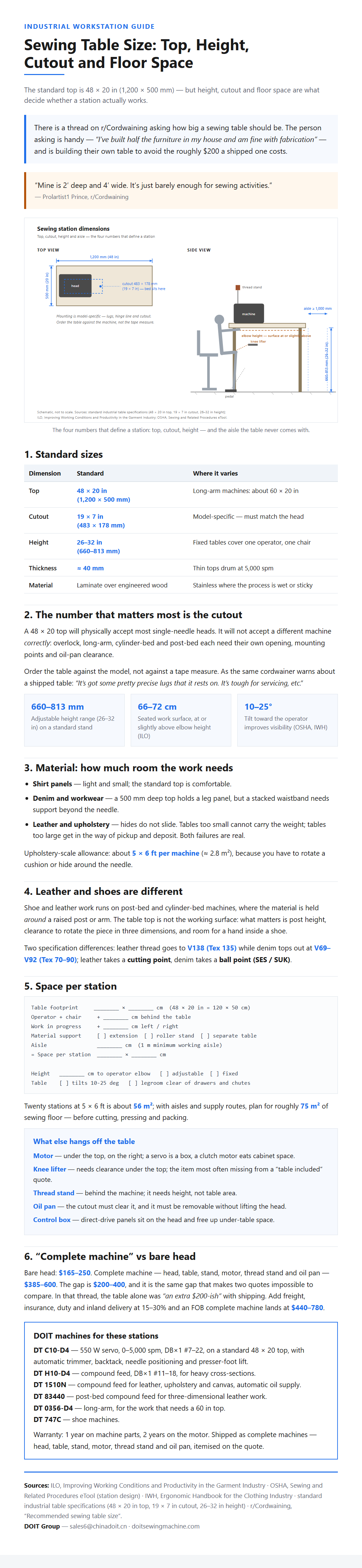
The four numbers that define a station: top, cutout, height — and the aisle the table never comes with.
Which Number Matters Most?
Not the top. The cutout.
A 48 × 20 top will physically accept most single-needle heads. What it will not do is accept a different machine correctly: an overlock, a long-arm walking-foot, a cylinder-bed or a post-bed each need their own opening, their own mounting points, and in some cases their own oil-pan clearance. Machine makers publish table-cut drawings precisely because the opening is model-specific, and tables are routinely cut to order against a model number.
Order a table against the model, not against a tape measure. If a supplier asks what the machine is before quoting the table, that is a good sign, not a slow one.
That thread also shows why a table is risky to improvise even for a capable builder. The machines do not simply sit on a top — as the same cordwainer warns about a shipped table, "It’s got some pretty precise lugs that it rests on. It’s tough for servicing, etc." The lugs, the hinge line and the cutout are model-specific; get them wrong and the head sits level, but the service access is gone.
The machine classes differ more than their footprints suggest:
|
Machine |
Table requirement |
|
Single-needle lockstitch |
Standard 48 × 20 in top, 19 × 7 in cutout |
|
Long-arm walking foot |
About 60 × 20 in; the arm is the reason |
|
Overlock / safety stitch |
Its own cutout and oil-pan clearance. Some heads are fully submerged in the cabinet and need a two-table set supplied as a pair |
|
Cylinder bed |
The arm projects to the operator, so the clearance is beside the machine, not under it |
|
Post bed |
The post rises above the top; the requirement is space to rotate the piece in three dimensions, not top area |
If you are buying three different machine types, you are buying three different table cuts. That is the part of the order that arrives wrong most often, because it is the part specified last.
How High Should the Surface Be?
The height rule is one sentence, and it comes from occupational health sources rather than from furniture catalogues:
The work surface should be at, or slightly above, elbow height when the operator is seated with feet flat and shoulders relaxed.
The ILO’s action manual for the garment industry puts the seated working height at around elbow level — in the 66–72 cm range for most tasks, with the chair (not the table) absorbing the difference between operators. The same sources make three more points that a factory can act on immediately:
- Too low and the operator hunches — strain in the back, neck and shoulders.
- Too high and the shoulders rise — neck and upper-back pain by the end of the shift.
- A slight tilt toward the operator (10–25°) improves visibility of the work and keeps the neck more upright. On heavy material, tilting away can help the fabric feed through under its own weight.
The 26–32 in (660–813 mm) range on a standard adjustable stand covers nearly every operator and both seated and standing work. A fixed-height table covers one operator on one chair, and it will be wrong for the next person who sits down.
How Much Room Does the Material Need?
This is where the 48 × 20 top stops being enough, and it is the part most size arguments miss.
Three materials behave very differently on the same table:
- Shirt and blouse panels — light, small, and the standard top is comfortable.
- Denim and workwear — panels are big and the assembly is heavy. A 508 mm deep top will hold a leg panel, but a waistband assembly with a stack of plies needs support beyond the needle, or the operator is lifting the weight of the garment with their wrists.
- Leather and upholstery — hides do not slide, and the work is heavy all the way through. The ergonomics literature is blunt about it: some tables are not large enough to support the weight of the garment, and the fix is an extension, a raised edge, or a separate support — not a bigger machine.
The same literature warns about the opposite failure: a table that is too large gets in the way of pickup and deposit, especially where carts or rails bring the work to the operator. Bigger is not the answer; the right size for the work is.
For upholstery-scale work, a working allowance is about 5 × 6 ft per machine, because you have to be able to rotate a cushion or a hide around the needle, not just feed it through.
What About Leather and Shoes?
Different again — and this is where the Cordwaining question gets interesting. The same 2′ × 4′ table that is barely enough for shoe work carries a surprising range on the side: "belts, bags, wallets, jeans, sand and other stuff there" — but only because the machine on it is sized to the work: "my machine is pretty big though, it takes up the majority of the space." On a small top, a big head is the space plan.
Shoe and leather work is largely done on post-bed and cylinder-bed machines, where the material is held around a raised post or arm rather than lying flat on a table. For that work the table top is not the working surface at all: what matters is the height of the post or arm, the clearance to rotate the piece in three dimensions, and the space to get a hand inside a shoe. A wide top helps only for the parts you set down between operations.
Two more differences worth putting in a specification:
- Thread: leather goes to V138 (Tex 135); denim tops out at V69–V92 (Tex 70–90). Specify the ticket number, not “heavy thread”.
- Needle point: leather takes a cutting point; denim and other wovens take a ball point (SES light, SUK medium) that parts the yarns instead of cutting them. Same machine, opposite needle.
And the machine class: leather and shoe uppers want compound feed or needle feed, not plain drop feed — a drop-feed machine will shift the plies on a hide the way it shifts them on heavy denim.
How Much Floor Space Does One Station Need?
The table is roughly half of it. The rest is the operator, the work in progress, and the aisle. Use this to plan a line:
Two things to check in that list that people skip: legroom (a drawer or a trash chute under the table removes it, and OSHA lists that as a hazard in its own right) and aisle width. A line planned only from table edge to table edge is a line that cannot be supplied, cleaned, or evacuated.
One cordwainer in that thread has the cell division exactly right: sewing at one 2′ × 4′ table, "another 2′ x 4′ table for skiving, gluing, etc.", a third for cutting panels, and a long bench in the shed for sanding, buffing, sole stitching and the eyelet and hook press. The sewing table is one station in a work cell — and the cell, not the table, is what the floor plan has to hold.
For a rough planning figure on the upholstery scale: one machine at 5 × 6 ft (1.52 × 1.83 m) is about 2.8 m². Twenty machines is therefore about 56 m² of station space, and with aisles and supply routes at roughly a third on top, you are planning for something in the order of 75 m² of sewing floor — before cutting, pressing, finishing and packing. It is an estimate, and it is the kind of estimate you want to make before the lease is signed rather than after the tables arrive.
What Else Hangs Off the Table?
A sewing table is a mounting frame before it is a work surface. Before you order one, decide where these go:
- The motor — under the top, on the right. A servo is a box; a clutch motor is a heavy cylinder that determines how much of the cabinet you can use.
- The control box — direct-drive machines put the panel on the head, which frees under-table space entirely.
- The knee lifter — it needs clearance under the top and a lever in reach of the operator’s knee. This is the accessory most often missing from a “table included” quote.
- The thread stand — behind the machine, and it needs height, not table area.
- The oil pan — the cutout has to clear it, and the pan has to be removable without lifting the head.
What Does “Complete Machine” Include — and Why Does It Matter Here?
Because the table and the stand are half of the price difference between the two things a supplier might quote you.
- Bare head: $165–250. Just the machine.
- Complete machine — head + table + stand + motor + thread stand + oil pan — $385–600.
The gap is $200–400**, and it is the same gap that makes two quotes impossible to compare. The thread shows what that gap looks like at retail: *"With shipping it was an extra $200-ish for the table" — most of the head-to-complete difference, spent on a single line item, and that is before the motor, the thread stand and the knee lifter. When a quote says “table included”, make the supplier list those items; a table without a motor, a knee lifter or a thread stand is a machine that cannot run on the day it arrives. Add freight, insurance, duty and inland delivery at 15–30%, and a 385–600 FOB complete machine lands at **440–780*.
Where DOIT Fits
We build the machines that sit in those tables, and we ship them as complete machines — head, table, stand, motor, thread stand and oil pan, itemised on the quote.
- DT C10-D4 — 550 W servo, 0–5,000 spm, DB×1 #7–22, on a standard 48 × 20 in top with automatic thread trimmer, backtack, needle positioning and presser-foot lift.
- DT H10-D4 — synchronous top-and-bottom feed (compound feed), DB×1 #11–18, for the heavy cross-sections in denim and workwear.
- DT 1510N — compound feed for leather, upholstery, canvas and canvas goods, up to 2,500 spm, with automatic oil supply and pneumatic presser-foot lift.
- DT 83440 — post-bed compound-feed machine for the three-dimensional leather work above; 750 W, 2,500 spm.
- DT 0356-D4 — long-arm, for the work that needs a 60 in top.
- DT 747C — shoe machines. If you are reading this from the shoemaking side, that is where to start.
Send us the machine model and the garment or leather work it has to do, and we will quote the table cut to match it, with the height range specified rather than left to chance.
📩 Email: sales6@chinadoit.cn
🌐 Website: doitsewingmachine.com
References
- r/Cordwaining, Recommended sewing table size — comments quoted verbatim from the client-supplied screenshot of the thread (Prolartist1 Prince, a3seeze). https://www.reddit.com/r/Cordwaining/comments/1xau204/recommended_sewing_table_size/
- OSHA, Sewing and Related Procedures eTool — Station Design: work surface at elbow height; tilt toward the operator; padded or rounded edges; legroom; adjustable chairs. https://www.osha.gov/etools/sewing/station-design
- ILO, Improving Working Conditions and Productivity in the Garment Industry — An action manual: recommended dimensions for seated tasks, elbow-level work surface. https://www.ilo.org/sites/default/files/wcmsp5/groups/public/@ed_protect/@protrav/@safework/documents/instructionalmaterial/wcms_228220.pdf
- IWH, Ergonomic Handbook for the Clothing Industry (2001): sewing table height at or slightly above elbow height; tables too small to support garment weight and too large for pickup; 10–25° tilt; legroom problems from drawers and chutes. https://www.iwh.on.ca/tools-and-guides/ergonomic-handbook-clothing-industry
- Industrial table specifications: 48 × 20 in top (1,220 × 508 mm), 19 × 7 in cutout (483 × 178 mm), height adjustable 26–32 in (660–813 mm); about 40 mm top thickness where required. https://www.goldstartool.com/industrial-sewing-machine-table-with-k-leg-table-frame-assembly.htm
- Upholstery-space allowance of about 5 × 6 ft per machine. https://www.sewprousa.com/blog/best-upholstery-sewing-machines
- SCHMETZ, Sewing Focus: Denim — needle points for wovens (SES / SUK), thread size limits, stitch density.
-
Sewing Machine Needle Sizes Explained (With Fabric-to-Needle Chart)