What Is the Average Cost to Service a Sewing Machine?
What Is the Average Cost to Service a Sewing Machine?
For any garment factory, sewing machines are the backbone of production. When they break down or run badly, the whole line slows down. But what does it actually cost to keep them running?
The honest answer has three parts: the scheduled service, the unplanned repair, and the downtime that nobody puts on an invoice. Here is what each of them costs, and what you can do about all three.
1. What Is the Average Cost of a Basic Sewing Machine Tune-Up?
A real tune-up means the covers come off: de-linting the hook and feed area, oiling, balancing the tension, a timing check, and a test-sew on a couple of fabric weights. A service that is "a dusting and a drop of oil" is not a tune-up — it is a rental payment on the same problem.
|
Service |
Typical cost (US, 2026) |
|
Tune-up, domestic machine, in-shop |
$60 – $180 |
|
Flat-rate basic service |
about $95 – $110 |
|
Tune-up, industrial lockstitch |
$120 – $350 |
|
On-site service call |
$75 – $95/hour + travel |
|
Diagnostic fee if you decline the work |
$20 – $50 |
Key takeaway: for a floor of 50 machines, one scheduled industrial tune-up each per year is 50 × $120–350 = $6,000–$17,500, and that is before a single repair is counted. Four to five figures, every year.
2. What Do Common Repairs Cost?
|
Repair |
Typical cost |
|
Tension or feed adjustment (billed as a standalone visit) |
$60 – $100 |
|
Timing correction |
$75 – $180 |
|
Bobbin case or hook replacement |
$50 – $125 + part |
|
Needle bar or feed dog work |
$50 – $150 |
|
Motor replacement |
$100 – $250 |
|
Computerised control board |
$150 – $400+ |
Every one of those numbers should be roughly technician hours × $75–95, plus the part, plus travel. That is how you sanity-check a quote: if the three lines do not add up, ask which line is which.
One thing to be clear about: hook timing is not an operator job. The clearance between the hook point and the needle is set in hundredths of a millimetre. There is no way to see 0.05 mm, and there is no gauge in a sewing room that will do it. Timing belongs to a technician with the machine’s own manual in front of them.
3. How Much Does Annual Maintenance Cost for an Industrial Machine?
The rule of thumb most often quoted is that annual maintenance runs 5–8% of the machine’s value. Published estimates in fact spread much wider than that — from 2% at one end to 15% at the other.
Apply that spread to a 1,000–2,000 industrial lockstitch and you get:
- at 2–4%: $20 – $80 per machine per year
- at 5–8%: $50 – $160
- at 15%: up to $300
So the planning band is 20–300 per machine per year, and across 50 machines that is 1,000–15,000.
Two things follow from this, and both matter:
The percentages assume the daily work happens in-house. A 5–8% budget assumes your operators do the cleaning, oiling and needle changes, and that the outside technician is only called for periodic work and breakdowns. If you outsource every visit at 120–350, you will spend more than the band — which is why the §1 figure (6,000–17,500) sits above it. That is not a contradiction; it is the cost of a different service model.
The number worth using is your own. Take your last two years of service invoices and parts, divide by the replacement value of the fleet, and you have a benchmark for your floor. Any published percentage is only a starting point until you have done that.
Note also that these bands cover planned maintenance and parts. They do not include unplanned repairs, and they do not include a single minute of downtime.
4. Why Does the Same Repair Cost More for Some Machines?
Four things drive a service bill up, and only one of them is the technician’s hourly rate:
- Machine type. A mechanical lockstitch is the cheapest thing in the building to service. A computerised one adds a control board to the risk list, and boards are
150–400+. A compound-feed or walking-foot machine costs more than either, because the feed mechanism has more moving parts to wear and more to re-time when it does.
- Parts availability. A machine built on a common needle system, with standardised parts that are still in production, is cheap to keep running. A machine on a discontinued system is expensive even when the part is small, because someone has to find it. This is a purchase decision, not a service decision (see §10).
- Technician time and skill. In the US, roughly $75–95 an hour; in the UK, £75–95 an hour, which is about $95–120. Specialist work on automated and CNC units carries a premium, and unplanned repairs on advanced automatic machines are quoted in the hundreds to low thousands per incident.
- Travel. On-site work is often billed round-trip, and the travel line is frequently larger than the repair line on a short job.
5. How Much Does Downtime Cost Beyond the Repair Bill?
The invoice is the part you can see. The larger number is usually the one nobody measures.
The downtime cost of a breakdown is:
(operator hours idle × loaded labour cost) + (pieces not made × contribution margin per piece)
Both figures have to be yours. If a line that normally makes 1,000 pieces a day loses two hours, the second term is the two hours of output you did not ship, valued at your contribution margin — not at your selling price, and not at a number borrowed from someone else’s factory.
The visible half is an operator standing idle. The expensive half is the shipment that slips, the air freight that replaces a sea booking, or the penalty clause that gets triggered. In a high-volume factory those can exceed the repair bill several times over — which is the whole argument for spending money on prevention instead.
6. What Is the Difference Between Servicing a Home Machine and an Industrial Machine?
|
Domestic |
Industrial |
|
|
Tune-up |
$60 – $180, in-shop |
$120 – $350 |
|
On-site rate |
— |
$75 – $95/hour + travel |
|
Who does the daily work |
the owner |
the operator, every shift |
|
Frequency |
every 6–12 months |
continuously |
The important difference is not the hourly rate, it is the rhythm. A domestic machine is used for a few hours a week and serviced annually. An industrial machine runs all shift, every day, so "frequent service" mostly means daily operator cleaning — not daily technician visits. Get that split right and the maintenance budget stops being a surprise.
7. How Often Should a Sewing Machine Be Serviced?
Three layers, and the middle one is where most factories get it wrong:
Every shift — the operator:
- Brush and vacuum the lint out of the hook area, the feed dogs and under the needle plate. Do not blow compressed air into the oil paths; it drives lint deeper and into places a brush would have reached.
- Change the needle. Every 6–8 hours of actual sewing on general work; every 4–6 hours on denim and leather.
Lubrication — this depends entirely on the type of machine:
- Automatic oil pan and pump: the operator checks the sight glass between HIGH and LOW and tops up the pan. Oil is not added anywhere else.
- Semi-dry head: the head is dry by design. Only the hook is oiled. Adding oil to the head on this type is how you get oil-stained fabric.
- Manual oiling: one drop per oil point per shift, plus the hook oil reservoir. This is the "every 7–8 hours" rule you may have read, and it applies to this type only.
Over-oiling is its own defect. Oil travels down the needle bar and lands on the fabric, and oil-stained pieces are as unsellable as a broken seam. After oiling, run the machine briefly and wipe up what comes out.
Monthly and annually:
- Monthly: hook, feed dog height and timing.
- Annually: a full service and calibration, and a look at whether the machine is heading for the thresholds in §9.
8. What Are the Most Common Causes of Sewing Machine Breakdowns?
Before you call anyone, do the three checks that resolve a large share of "broken" machines for the price of a needle:
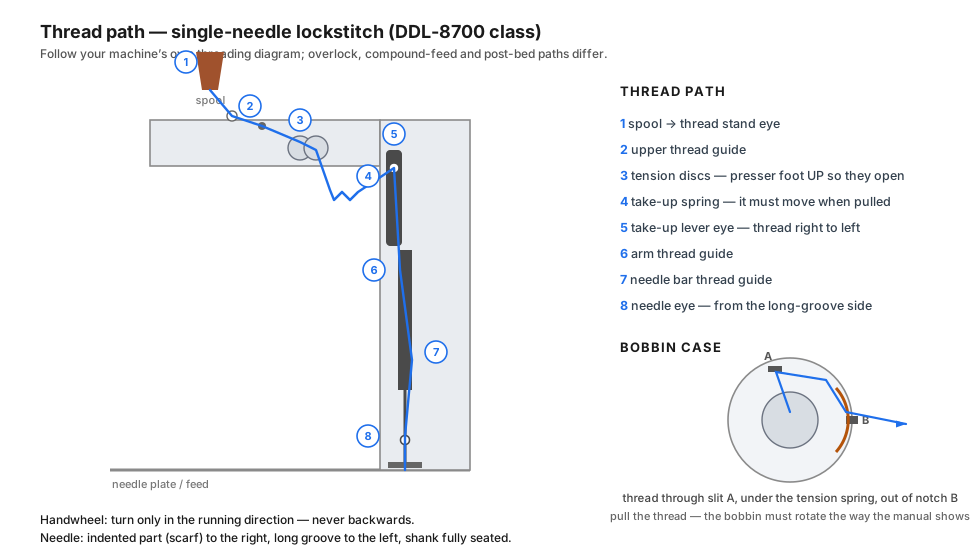
- Rethread from scratch, with the presser foot up and a fresh needle fitted.
- Fit a new needle. Nine times in ten, skipped stitches are a dull, bent or wrong-type needle. Needles are consumables, not machine parts.
- Clear the lint under the needle plate and around the hook.
If it still misbehaves, the usual causes are:
- Lint and dust packed in the hook area
- A dull or bent needle (or the wrong needle system or size for the material)
- Incorrect thread tension
- Skipped lubrication — or the opposite, over-oiling
- Timing knocked out by a needle break or a jam
Nearly all of those are operator-preventable, which is why the daily routine in §7 is the cheapest maintenance you will ever buy.
9. Is It Cheaper to Repair an Old Machine or Buy a New One?
The 50% rule is a good instinct, but it has to be applied to the right comparison. A $150 quote on a $199 entry-level machine is absurd — let it go. The same $150 on a machine that cost $800 new is 19%, and it is a clear repair.
For an industrial lockstitch the rule rarely fires. A new direct-drive computerised machine is 1,700–2,900, so half of that is **850–$1,450**. A $100–250 motor or servo job is 4–15% of a new machine — that is a repair, every single time, not a replacement.
What actually tells you to replace is not one big bill, it is a pattern:
- Annual upkeep — service, parts and downtime — above 10–15% of a new machine’s price
- Unplanned downtime above about 5% of shift hours
- Rework or defect rate climbing for no visible reason
- You added a shift and output did not move
If you are not seeing at least one of those, you are not looking at a replacement decision. You are looking at a maintenance problem, and there is a cheaper fix for it.
10. How Can You Reduce Long-Term Service Costs?
There are three paths, and the middle one is the one most articles skip:
1. On the machines you already own — retrofit the motor. A belt-type servo retrofit costs $100–250 per machine and removes the clutch motor and its brake assembly, which is the single most common source of service calls on an older machine. It also cuts the energy those motors waste by 60–70% at the same time. Be realistic about what it does not do: automatic thread trimming, back-tack, needle positioning and automatic presser-foot lift are not retrofit add-ons. They come with the machine or they do not come at all.
2. When you buy, buy the maintenance profile — not just the spec sheet. Four things to specify:
- Direct-drive servo. No drive belt, no clutch motor, no brake assembly to adjust.
- The lubrication system. An automatic oil pan removes the daily oiling task entirely; a semi-dry head needs only the hook oiled; a manual-oiling machine needs one drop per point per shift. This is a daily-work decision, and it is made at purchase.
- Stepper control of stitch length and presser-foot height, set on the panel. No cam changes, no manual re-setting between styles.
- A needle system that is stocked in your market.
3. Train operators on the daily routine. Cleaning, needle changes and oil discipline prevent most of the failures in §8. They cost a needle and two minutes.
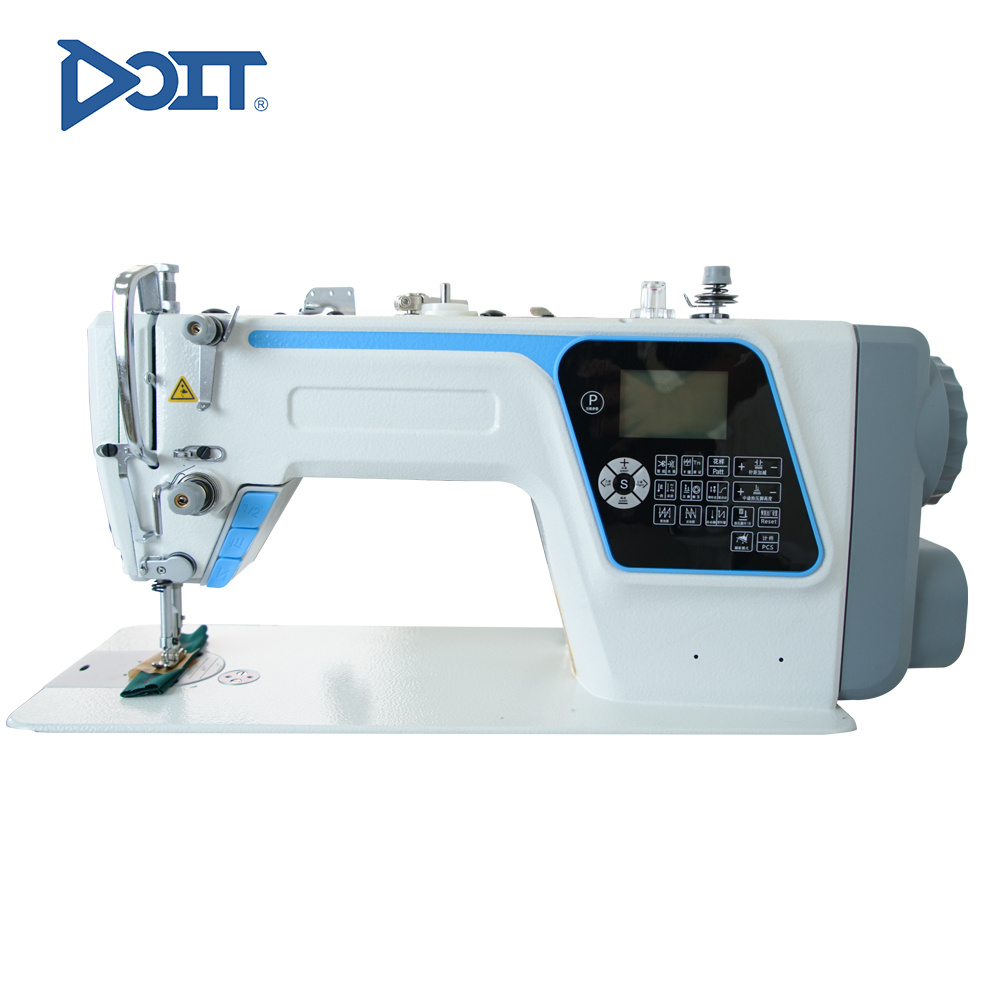
The Shortlist: DOIT C10-D4 Direct-Drive Computerized Lockstitch
If you are replacing or adding, this is the configuration we build for factories that cannot afford downtime:
- Direct-drive 550 W servo head, 0–5,000 spm. No drive belt, no clutch motor, no brake assembly.
- Stepper-motor control. Stitch length and presser-foot height are set on the LCD — no cam changes and no manual re-setting when you change styles.
- Automatic thread trimming, back-tack, needle positioning and presser-foot lift as standard.
- DB×1 #7–22 needle system. This is the same system the Juki DDL-8700 class uses, and it is the most widely stocked industrial needle system in the world. (135×17 / DP×17 is the compound-feed and walking-foot system; the two are not interchangeable, and a needle from the wrong system sits at the wrong height for the hook.)
- 220 V / 110 V selectable, 50/60 Hz.
Two things to confirm in writing before you order, because they change your daily routine and your parts list: which lubrication system the head uses, and the needle system for the exact model you are quoted.
The Bottom Line
A tune-up is $60–180 on a domestic machine and $120–350 on an industrial one. A timing job is $75–180, a motor is $100–250, and a control board is $150–400+. Across a 50-machine floor that is four to five figures a year in scheduled service, plus the repairs and plus the downtime — and the downtime is the number that usually hurts most.
The cheapest machine to service is the one that was bought with its maintenance profile in mind, and the cheapest repair is the one the operator prevented.
Ready to reduce your sewing machine service costs?
Explore the DOIT C10-D4 at doitsewingmachine.com
📩 Email: sales6@chinadoit.cn 🌐 Website: doitsewingmachine.com
Are Old Sewing Machines Worth Money? The Truth About Vintage vs. Modern Industrial Value
3-Thread vs 4-Thread vs 5-Thread Serger: A Technical Comparison for Professional Buyers