What Needle Should I Use for Sewing Jeans? The Complete Denim Needle Guide
What Needle Should I Use for Sewing Jeans? The Complete Denim Needle Guide
1. Why can't I just use a standard sewing needle for denim?
Denim — especially heavy jeans denim — is a punishing fabric. Its coarse, dense weave and the multiple layers at fly fronts and hems put extraordinary stress on any sewing machine needle. A standard universal needle may pierce lightweight chambray, but on heavy 14 oz denim it often bends, breaks or causes skipped stitches. That's why denim demands a specialized needle built specifically for the job.
2. What type of needle works best for denim?
For denim, always use a jeans/denim needle. These needles feature an extra sharp point (for cleanly cutting through dense fibers) and a reinforced, extra‑strong shaft that resists bending or breaking when hitting thick seams. On domestic machines using the HA×1 (130/705 H) system, jeans needles are widely available from brands like Schmetz, Singer and Organ, with Schmetz being the industry gold standard for consistent quality. Most denim needles are labelled "Jeans" or "Denim" on the packaging. They are also sometimes called "Denim Needles" or "Heavy Duty Sharp Point Needles." Schmetz markets two specific point geometries for denim: "SES" (for light denim) and "SUK" (for medium to heavy denim).
3. What are the recommended needle sizes for different denim weights?
Your needle size depends entirely on the weight of the denim you are sewing (measured in ounces per square yard). Here is the practical size guide:
| Denim Weight | Recommended Needle Size (Metric / Imperial) | Typical Application |
|---|---|---|
| Lightweight (8–10 oz) | 80/12 or 90/14 | Summer jeans, lightweight jackets, fashion pieces |
| Medium weight (10–12 oz) | 90/14 (the standard) | Classic everyday jeans, skirts, jackets |
| Heavyweight (12–14 oz) | 100/16 | Workwear jeans, heavy canvas, thick denim jackets |
| Extra-heavyweight (14–16 oz) | 110/18 | Raw denim, multi‑layer seams at fly, waistband and hem intersections |
| Extreme duty (16+ oz or multiple layers) | 120/19 or 130/21 | Highly layered stacks (side‑seam hem crosses of up to 9 layers) |
For lightweight and medium-weight denim, sizes 80/12 or 90/14 are ideal because they offer enough strength to pierce the fabric without leaving oversized holes. For classic everyday jeans (10–12 oz), the 90/14 needle is the gold standard, offering the best balance of strength and precision. Heavyweight denim (12–14 oz) and above demand larger needles: 100/16 or 110/18. If you are using thick topstitching thread, you will need a 100/16 needle because its eye is larger to accommodate heavier thread.
4. What needle system do industrial sewing machines use for denim?
Industrial lockstitch machines use a completely different needle system: typically 135×17 (sharp point for fabric and canvas) or 135×16 (leather point). The 135×17 needles are the default for woven fabrics and general heavy‑duty sewing. The system 135×16 is the same physical needle size, but its point is specially ground for leather and heavy upholstery. For pure denim production, sharp point needles (135×17) are the correct choice. For denim that contains polyurethane coatings or is sewn with extremely thick thread, some factories switch to titanium‑nitride coated variants (e.g., Groz‑Beckert GEBEDUR™) which have a characteristic golden appearance and deliver much longer service life between changes.
5. What size industrial needle should I use for denim?
| Needle System | Denim Weight | Needle Size NM (Metric) | Sharp/Leather Point |
|---|---|---|---|
| 135×17 / DP×17 | Light – medium (8–12 oz) | NM 90 – NM 110 (14–18) | Sharp point (woven fabrics) |
| 135×17 / DP×17 | Heavy – extra‑heavy (12–16 oz) | NM 110 – NM 130 (18–21) | Sharp point (woven fabrics) |
| 135×16 / DP×16 | Heavy coated or highly layered | NM 110 – NM 130 (18–21) | Leather point (cuts through coatings without tearing) |
Schmetz lists a full working range of NM 70 to NM 140 for denim sewing, confirming that both domestic HA×1 needles and industrial 135×17 needles follow the same sizing logic for denim.
6. What happens if I use the wrong needle size?
| Wrong Choice | Likely Problem |
|---|---|
| Needle too small (#11/#14 on heavy 14 oz denim) | Needle bends, deflects off thick seams, or breaks. Thread shreds because the eye is too small |
| Needle too large (#20 on lightweight 8 oz denim) | Permanent oversized holes visible after washing. Fabric damage, especially on fine denims or chambray |
| Ballpoint needle instead of sharp point | Needle pushes fibers apart rather than cutting through, causing massive skipped stitches on seams and a dull, woolly seam appearance |
If you ever hear a dull "thump" as the needle enters a thick seam intersection, or the machine starts skipping stitches randomly at high speed, you are almost certainly using a needle that is too slender for the stack of fabric layers, or a dull needle that has worn past its useful life.
7. How often should I change my needle when sewing denim?
A general rule across the sewing industry is to change the needle every 6–8 hours of actual stitching time under normal fabric loads. Under heavy denim loads (regularly sewing seams thicker than 6‑8 mm), that interval should be shortened to every 4–6 hours of use. You should also change needles immediately at the first broken thread, skipped stitch, or abnormal noise. For high‑volume denim factories, a needle‑change schedule every shift (8 hours) plus an extra spare needle for each machine at the start of the second shift is standard practice.
8. What are the signs that my needle needs replacing right now?
| Symptom | Indicates |
|---|---|
| Fabric snagging or pulling during normal sewing | Burr or flat spot on needle point |
| Thread shredding or breaking repeatedly after changing tension | Needle eye may have developed a burr |
| Skipped stitches every few inches, especially on heavy stacks | Needle is blunt or bent |
| A clunking noise or "thump" as the needle enters each thick seam | Needle is deflecting and hitting the edge of the needle plate hole |
| Visible bent shaft when you roll the needle across a flat table | The needle is unsafe to use and must be discarded immediately |
For contract sewing lines where minor defects are unacceptable, many denim manufacturers schedule a programmed needle‑change at the start of every shift regardless of visible condition.
9. Can I use a regular sharp point needle for denim, or do I really need a special denim needle?
You can use a standard sharp point needle (sometimes called a "regular point" or "sharp point" in industrial 135×17 packaging) and it will cut through denim acceptably. However, a dedicated denim/jeans needle is engineered with a reinforced blade that is roughly 20–30% stiffer than a standard sharp needle of the same gauge. That stiffness drastically reduces deflection when the needle hits the compressed, folded layers of a jeans fly or side‑seam hem. In production testing, denim‑specific needles reduced needle‑break incidence by approximately 60–70% compared to universal sharps of the same size.
10. What if I'm sewing stretch denim containing spandex?
Stretch denim introduces a second challenge: the fabric can move away from the needle point as it tries to push the elastic fibers apart. For stretch denim, Husqvarna's industrial sewing guidance recommends using a stretch needle (available in domestic HA×1 systems) rather than a standard jeans needle. A stretch needle features a specially shaped scarf (the cutout above the eye) that helps the loop‑forming hook grab the thread reliably when sewing elastic materials. It also uses a more gradual point geometry that reduces the risk of skipped stitches on high‑stretch fabrics. Most major needle brands label stretch needles as "Stretch" rather than "Jeans".
11. What size and type of thread should I pair with my denim needle?
Needle and thread form a working system — the thread cannot be heavier than the needle can accommodate.
| Denim Weight | Needle Size | Recommended Thread |
|---|---|---|
| Lightweight (8–10 oz) | 80/12 or 90/14 | #50–#60 polyester or core‑spun thread |
| Medium (10–12 oz) | 90/14 | #50–#60 polyester or heavy all‑purpose (#40) |
| Heavyweight (12–14 oz) | 100/16 | #40 topstitching thread or V69 industrial poly |
| Extra‑heavy (14+ oz) | 110/18 – 130/21 | V92–V138 bonded polyester (industrial) |
For general garment construction on standard 12 oz denim, #50–#60 thread with a 90/14 needle is a safe starting combination. For visible topstitching where you want the classic jeans look, use #40 topstitching thread or V69 bonded polyester paired with a 100/16 needle. Never use rayon thread for denim construction — it has poor abrasion resistance and will shred at high speeds or when rubbing against heavy folded seams.
12. What is the correct stitch length for denim?
Denim demands a longer stitch length than lightweight fabrics. A stitch length that looks neat on quilting cotton will be too short for denim, actually weakening the seam by creating too many perforations and potentially causing thread breakage. For heavy‑duty denim, you want longer stitches for both seam strength and a cleaner appearance.
| Denim Type | Recommended Stitch Length (mm) |
|---|---|
| Lightweight denim (8–10 oz) | 2.5 – 3.0 mm |
| Medium weight denim (10–12 oz) | 3.0 – 3.5 mm |
| Heavyweight denim (12–14 oz) | 3.5 – 4.0 mm |
| Extra‑heavy denim / multi‑layer seams | 4.0 – 4.5 mm |
As a rule: increase normal stitch length by about 0.5–1.0 mm when moving from light fabric to denim. On many lockstitch machines, a stitch length setting of 3.0–3.5 mm is a safe starting point for standard jeans.
13. What tension setting should I use for denim?
Thread tension — the amount of resistance applied to the upper thread before it reaches the needle — must be increased for dense denim to pull the thread smoothly through thick material stacks. A good starting point on a typical industrial lockstitch is a dial setting of 5–6 out of 0–9 scale. For lighter 8–10 oz denim, start at 5. For heavy 14 oz denim, start at 5.5 or 6. For stretch denim, start slightly lower (around 4.5) because you want the seam to relax rather than pucker. The final test: the upper and bobbin thread locks should be buried exactly in the middle of the fabric layers, not visible on the top or bottom surface.
14. What are the most common needle‑related problems when sewing denim?
| Problem | Most Likely Cause |
|---|---|
| Needle breakage at seam crossing | Needle too small (#14/#90 or smaller on 14+ oz denim) OR old, weakened needle beyond 6–8 hours of use |
| Skipped stitches (especially on thick stacks) | Needle is blunted, or point geometry wrong (ballpoint will skip on heavy twill) |
| Thread shredding or fraying | Needle eye has burr, or needle size too small for thread thickness (thread friction generates heat and shreds) |
| Bent needle after sewing | Hit a pin, a metal clasp, or a hardened seam too many times without replacing |
| Melted or gummy thread residue inside needle eye | Excessive needle heat from high‑speed sewing on coated denim; reduce speed or use a needle with titanium‑nitride coating (SES/SUK or Groz‑Beckert GEBEDUR™) |
15. Are there any special denim needles for automatic industrial machines?
Yes. Modern denim factories use automatic pocket setters, bartack machines and short‑seam automats. These specialized machines still use 135×17 system needles, but they often require SERV 7 needles — a heavy‑duty variant with a specially hardened blade and reinforced scarf, designed to withstand the high stresses of automated feeding and multiple rapid penetrations per second. If you operate automated denim equipment, check your machine manual for the specific needle system and SERV grade required, as standard 135×17 needles may fail prematurely.
16. Can I use the same needle for both denim and heavy canvas upholstery?
Similar rules apply, but with a twist. For natural heavy canvas (uncoated), a 135×17 sharp point size 100/16–120/19 works well. However, for canvas that has been treated with water‑repellent coatings or polyurethane laminates, you may need a needle with a different point profile: either a "R" regular round point (slightly sharper than standard sharp) or a "DI" diamond point for cutting through tough surface layers cleanly. Coated vinyl upholstery materials, by contrast, often call for a 135×16 leather point needle to cut a clean slit rather than pushing a large hole. Always test on a scrap piece before committing to full‑line production.
17. How should I dispose of used needles safely in a factory environment?
Used industrial needles are a safety hazard. They are sharp, can penetrate standard trash bags, and cause puncture injuries to cleaning staff and waste handlers. Standard factory safety protocol: collect used needles in a rigid, puncture‑resistant "sharps" container (similar to medical sharps disposal bins). When the container is full, seal it and dispose of it according to local industrial waste regulations — typically as metal scrap recycling rather than general waste. Many needle manufacturers also provide needle collection boxes with their bulk packaging. Never discard loose needles in fabric waste or general trash bins.
18. What needle does DOIT Group recommend for denim sewing on its industrial machines?
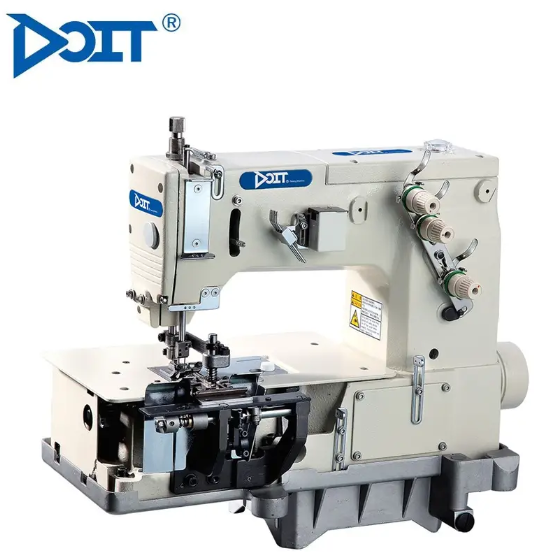
DOIT Group's industrial lockstitch machines — including the DT 5550 standard lockstitch, the DT8800-D4 direct‑drive with auto‑trimmer, the DT C10-D4 computerized lockstitch with stepper motor, and the multi‑needle DT 1508P double chainstitch machine for waistbands — all use the standard 135×17 (DP×17) sharp point needle system. For general denim production:
-
8–10 oz lightweight denim: 135×17, size NM 90–100 (#14–16)
-
10–12 oz medium denim: 135×17, size NM 100 (#16)
-
12–14 oz heavy denim: 135×17, size NM 110–120 (#18–19)
-
14 oz+ extra‑heavy denim or multi‑layer stacks: 135×17, size NM 120–130 (#19–21)
For stretch denim containing spandex, DOIT recommends staying with 135×17 sharp point but increasing needle size by one step and slightly lowering stitch length (3.0 mm) to maintain loop formation.
Need a complete denim sewing solution for your factory?
DOIT Group offers a full range of industrial lockstitch, overlock, and multi‑needle chainstitch machines built for continuous denim production. From the DT 5550 general‑purpose lockstitch to the DT C10-D4 computerized model with stepper motor control, all DOIT machines are ISO9002‑certified, available with direct‑drive servo motors (saving up to 70% on electricity), and compatible with standard 135×17 industrial needles. Contact us for a free equipment consultation, a needle selection guide tailored to your specific denim line, or a request for quotation.
📩 Email: sales6@chinadoit.cn
🌐 Website: doitsewingmachine.com
How expensive is it to make your own jeans?
How to Use an Automatic Threader on a Sewing Machine