What Should I Buy as a Beginner Sewer? Your Complete Starter Guide

What Should I Buy as a Beginner Sewer? Your Complete Starter Guide
So you've decided to learn to sew. Congratulations — you're about to discover one of the most rewarding, creative, and practical skills you can pick up. But before you can stitch your first seam, you face a question that stops many beginners in their tracks: What do I actually need to buy?
The sewing world is full of gadgets, accessories, and machines with hundreds of stitches — and it is easy to feel overwhelmed. Here is the good news: you do not need an expensive machine to start. Good beginner-friendly sewing machines cost between $150 and $300 and will serve you well for years. This guide cuts through the noise and tells you exactly what to buy — no more, no less.
1: The Machine — Your Most Important Purchase
Choosing your first sewing machine is exciting but can feel like a huge decision. With so many brands, features, and price points, how do you choose? Start by understanding the two main types of machines available to beginners.
Mechanical vs. Computerized — Which One Is Right for You?
Mechanical sewing machines operate with manual controls — you adjust stitch length, width, and tension using dials and levers. They are straightforward, durable, and ideal for beginners or those who prefer simplicity. Mechanical machines also tend to be more affordable and easier to maintain.
Computerized sewing machines are equipped with buttons and a digital or LCD screen. They offer automatic features, a wider range of built-in stitch patterns, and often include helpful on-screen guidance. Models like the Brother CS7000X offer a wide range of built-in stitch patterns, automatic thread cutters, and digital controls for precision sewing.
Which should you choose? If you want simplicity, lower cost, and a machine that is easy to fix and maintain, start with a mechanical machine. If you want room to grow, enjoy technology, and plan to explore quilting or decorative stitching, a computerized model may be a better long-term investment.
Essential Features Every Beginner Should Look For
Whatever type you choose, look for these features:
| Feature | Why It Matters |
|---|---|
| Basic stitches (straight + zigzag) | All you really need to start |
| Adjustable stitch length and width | Gives you control over your sewing |
| Automatic needle threader | Saves frustration — trust us on this! |
| Good LED light | Essential for seeing your work clearly |
| Speed control function | Lets you sew slowly while building confidence |
| Drop-in bobbin | Easier to thread and monitor than front-loading systems |
| Free arm | Makes it easier to sew sleeves, cuffs, and trouser legs |
Recommended Beginner Models
Several models consistently receive high praise from beginners and experts alike:
-
Brother CS7000X — A beginner-friendly computerized machine with a durable metal frame, wide range of built-in stitches, and speed control. Perfect for new sewists who want room to grow.
-
Singer Heavy Duty 4423 — A mechanical machine that can handle heavier fabrics and grow with your skills. Straightforward, durable, and easy to carry around.
-
Brother XR9550 — The Good Housekeeping Institute's best overall pick for beginners. Simple design, small learning curve, and less expensive than many popular models. Features a drop-in bobbin and easy-to-follow threading guides.
-
Pfaff Smarter — A highly rated beginner machine from a trusted brand.
-
Janome Arctic Crystal — Beginner-friendly with solid build quality and a user-friendly design.
Pro tip: Visit local sewing machine dealers to test different models. What feels comfortable to one person might not work for another. Many dealers also offer free classes when you purchase a machine, which is valuable for beginners.
2: The Essentials — Your Starter Tool Kit
Once you have your machine, you will need a few basic tools. Here is your starter kit:
The 8 Essentials
| Tool | Why You Need It |
|---|---|
| Fabric scissors | Invest in good shears and use them ONLY for fabric — paper will dull them quickly |
| Seam ripper | Your best friend for fixing mistakes. Everyone makes them! |
| Pins and pincushion | For holding fabric pieces together before sewing |
| Quality needles and thread | Match your thread weight to your fabric. Good-quality polyester all-purpose thread is a strong all-rounder for beginners |
| Measuring tape | Essential for accurate cutting |
| Fabric marking tools | Chalk or water-soluble markers for pattern markings |
| Iron and ironing board | Pressing is half of good sewing |
| Fabric | Start with quilting cotton — it is stable, does not stretch, and is easy to work with |
Optional But Helpful
-
Rotary cutter, quilting ruler, and rotary mat — Great for cutting straight lines and quilting projects
-
Hand sewing needles in different sizes — For finishing touches and repairs
Budget tip: You can get away with a cheaper pair of scissors, just be sure not to use them for anything other than fabric. Start sewing without breaking the bank by choosing beginner-friendly fabrics that are easy to work with and budget-conscious.
3: Your First Projects — Start Simple
Before you tackle a complex garment, build your confidence with simple projects. Here are some great first projects for beginners:
-
Fabric coasters
-
Tote bags
-
Scrunchies
-
Pillowcases
-
Felt key rings
-
Simple aprons
These projects teach you straight stitching, turning corners, and basic construction — without the frustration of zippers, buttons, or complex fitting.
4: Beyond the Basics — When to Consider Industrial Equipment
If your goal is to start a small garment business or scale up production, a home sewing machine will eventually limit you. Home machines max out around 800–1,100 stitches per minute and are not designed for continuous daily operation. Industrial machines run at 4,000–5,500 stitches per minute — four to five times faster — and are built for 8-hour shifts.
DOIT Group, a professional manufacturer based in Taizhou, Zhejiang — China's sewing machinery hub — produces a full range of industrial sewing machines suitable for serious small businesses and garment factories. With over 95% of its products exported to more than 20 countries across America, Europe, Asia, Africa, and Latin America, DOIT has built a reputation for reliability and value.
Key DOIT models for those moving beyond beginner status:
-
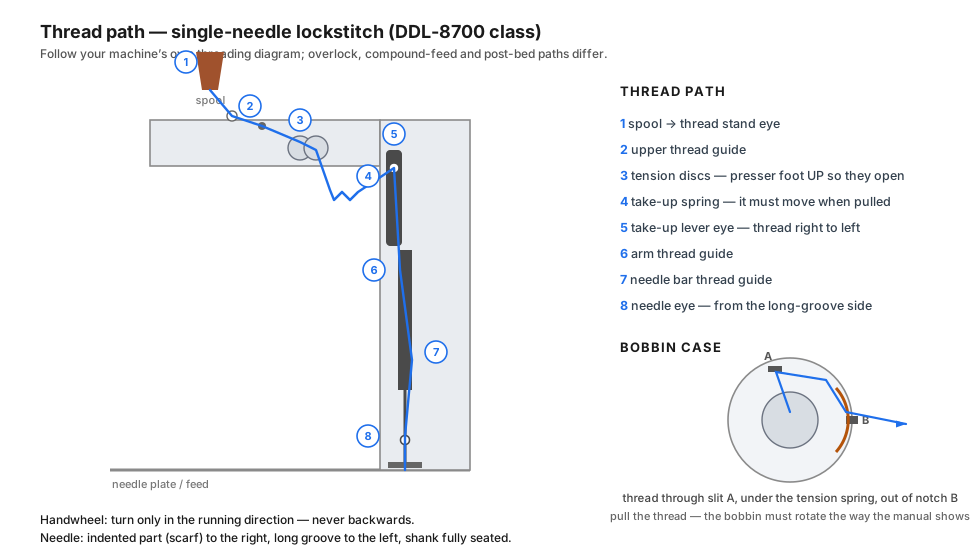
DT 5550 High-speed Single-needle Lockstitch — The workhorse for daily assembly. Handles up to 13mm sewing thickness, making it capable of denim and heavy fabrics. Maximum speed of 5,000 SPM. Ideal for general garment construction.
-
DT 8800-D4 Direct Drive Full Automatic Lockstitch — Features a direct-drive servo motor that saves up to 70% on electricity compared to traditional clutch motors. Includes automatic thread trimming and a 15mm presser foot lift for bulky seams.
-
DT 940-4AT High-speed Automatic Overlock — Essential for professional edge finishing. Sews, trims, and finishes edges in a single pass at speeds up to 7,000 RPM. Perfect for T-shirts, activewear, and knit garments.
All DOIT machines are manufactured under ISO9002 quality standards, with many models carrying CE, UL, and TUV certifications. With a one-year warranty on machine parts and a two-year warranty on the motor, DOIT stands behind its equipment.
The Bottom Line: Your Starter Shopping List
| Priority | Item | Estimated Cost |
|---|---|---|
| Must-have | Beginner sewing machine ($150–$300) | $150–$300 |
| Must-have | Fabric scissors | $15–$40 |
| Must-have | Seam ripper | $5–$10 |
| Must-have | Pins and pincushion | $5–$15 |
| Must-have | Quality thread (several colors) | $10–$20 |
| Must-have | Measuring tape | $5–$10 |
| Must-have | Fabric marking tools | $5–$15 |
| Must-have | Iron and ironing board | $30–$100 |
| Must-have | Starter fabric (quilting cotton) | $10–$30 |
| Nice-to-have | Rotary cutter + mat + ruler | $30–$60 |
| Total starter investment | $265–$600 |
The most important thing to remember: you do not need everything at once. Start with the machine and the 8 essentials, buy fabric as you need it, and add tools as your skills grow. Sewing is a journey — and every expert was once a beginner who made mistakes, unpicked seams, and kept going.
Ready to start your sewing journey with the right equipment? DOIT Group offers a full range of industrial sewing machines for beginners and growing businesses alike. Contact us for a free consultation and equipment recommendation.
📩 Email: sales6@chinadoit.cn
🌐 Website: doitsewingmachine.com
What Is the Most Trouble‑Free Sewing Machine?
How do you pick your first sewing machine?