Sewing Machine Squeaking: Where the Noise Comes From, and How to Fix It
Sewing Machine Squeaking: Where the Noise Comes From, and How to Fix It
Somebody on r/sewhelp posted the question every operator asks eventually: their sewing machine has started squeaking, and they want to know what it is before it becomes a repair. It is a good question because a squeak is one of the few faults that tells you exactly what is wrong — as long as you know how to listen to it.
Almost every squeak is one of four things: metal running dry, a belt that is slipping, lint packed where the oil should be, or something mounted on the table rather than inside the machine. Here is how to tell which, without guessing and without reaching for the wrong can.
What Is the Sound Telling You Before You Open Anything?
Two things to note with every noise: when it happens, and how fast it repeats.
|
What you hear |
When |
Most likely source |
|
A sharp chirp, once per stitch |
In time with the needle bar |
Needle bar or take-up linkage running dry, or the needle touching something |
|
A continuous squeak that stays with the needle out |
Any speed |
Hook and hook race — dry, packed with lint, or a burred hook point |
|
A squeal that rises under load |
Crossing a thick seam |
Belt slipping on the pulley |
|
A rising hum with heat at the motor |
After 20–30 minutes |
Belt too tight, or a motor bearing |
|
A squeak that changes when you lean on the table |
Any time |
Table mounts, motor mount, pedal or knee lifter linkage |
|
A click or knock rather than a squeak |
Any time |
Timing or clearance — stop and call a technician |
That last row matters. A squeak is lubrication or a belt. A knock is geometry, and geometry is not an operator-level job.
How Do You Isolate the Noise in Ten Minutes?
Change one thing at a time and note what the sound does. In this order:
- Unplug, then turn the handwheel by hand. Squeak still there? Then it is the mechanism, not the motor.
- Remove the needle. Run again. Gone? It is the needle — a burr, a bend, or the wrong needle system.
- Take out the bobbin and the bobbin case. Run again. Gone? The hook race or the case is the source.
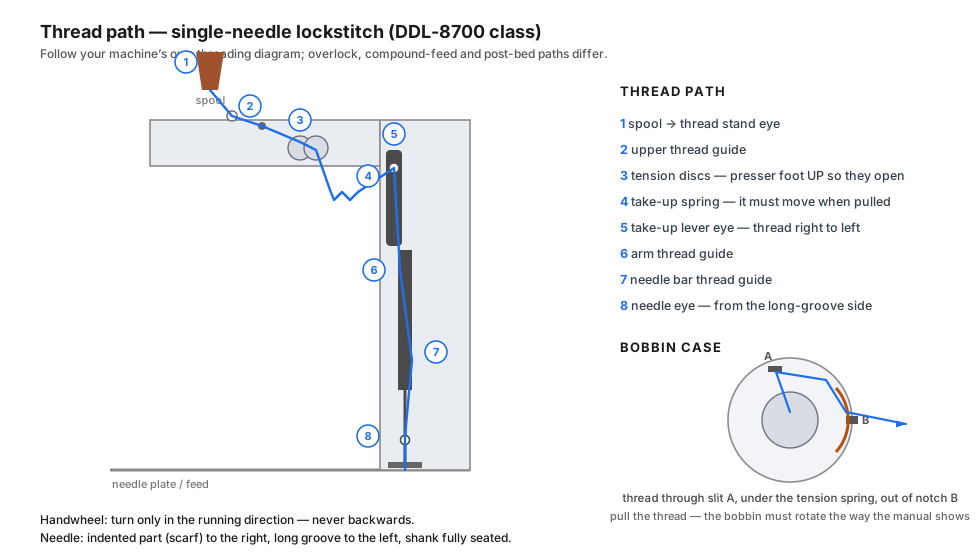
- Unthread the upper thread and remove the spool. Run again. Gone? It is the thread path, not the machine — often thread that has not seated in the tension discs.
- Raise the presser foot, then drop the feed dogs. Run again. A change points to the feed mechanism and its adjustment.
- Run on the start/stop button instead of the pedal. Gone? It is the pedal, not the head.
- Press on the table, and on the motor mount. Squeak that appears or moves is a loose table bolt or motor mount.
- Look at the belt while it runs under load. Squeal plus black dust under the machine means it is slipping.
- Feel the motor housing. Warm is normal; too hot to hold a hand on, with a squeal, is a belt or bearing problem.
- Write down which step changed the sound. That is your fault, and it is also your maintenance record.
Is It the Belt?
A slipping belt is the most common cause of a squeal that gets worse when the needle meets resistance — exactly the moment an operator would otherwise blame the thread or the needle.
Look for: black rubber dust under the motor, a glazed or shiny sidewall, cracks, or a belt sitting down in the bottom of the pulley groove instead of riding the flanks. A belt that slips needs either adjustment or replacement, and it is cheap next to the motor bearings and the shaft it protects.
If you want to measure tension, use your manual’s figure first. Published deflection numbers for sewing machine belts range from 5 mm to 15 mm depending on the source and the belt length, and printing one of them as universal is how a wrong number ends up on a factory’s PM sheet. In the absence of a manual figure, press the middle of the longest run with a thumb: too loose and it slips or squeals under load and speed sags at a thick cross-seam; too tight and you get heat at the motor bearings and a rising hum. Once a machine is set right, note where the motor sits and check against that every month.
Is It the Hook or the Needle Bar?
A once-per-revolution chirp that survives removing the needle points at the hook area, and there are only three usual causes:
- The hook race is dry. On a semi-dry head, the hook is the one part that still runs on oil — oil it at the specified point and nowhere else. Oiling a dry head everywhere else does not lubricate it, it just makes it attract lint.
- Lint is packed in the race. Denim and brushed fabrics generate a surprising amount of lint, and it compresses into the hook race and into the feed dog teeth. Clean before you oil, every time: oil on top of packed lint is how the problem becomes permanent.
- The hook point is damaged. A burred or nicked hook point damages thread on every single revolution. Burrs on the race and a damaged hook point are replaced, not polished.
On the needle-bar side, check three things before you adjust anything: the needle system (DB×1 for single-needle industrial lockstitch; 135×17 / DP×17 for compound feed; DC×27 for overlock — they are not interchangeable), the point (run a fingernail down the blade; a catch means replace), and the plate hole (1.60 mm for NM 100, 2.00 mm for NM 110/120 — too big and the loop is missed, too small and the thread jams). Needles are consumables: every 4–6 hours on denim.
Is It the Motor?
Which motor you have decides the whole answer.
- Brush-type motors — including the older clutch motors — wear carbon brushes as they run. Brushes are consumable, they are replaced in pairs, and roughly a third of the length left (about 5 mm remaining) is the point at which they are finished. Keep oil away from them: oil on brushes or on the commutator causes smell, sparking and loss of speed, not smoother running. Use the same grade and size when replacing.
- Servo motors have no brushes to replace. Their maintenance is short: keep the housing and its cooling path clean, keep the connections tight, and leave the inside alone. A servo that is running hot is usually a ventilation blockage or a belt that is slipping or too tight, not an electronics fault.
Motor bearings are the grey area. Some motors have oil points and the manual specifies them; oil what the manual specifies and nothing else, because excess oil near the commutator is a known cause of smell and speed loss.
And one absolute: anything electrical is done with the machine unplugged.
Heat is worth a second mention, because a squeak and a hot machine usually arrive together. The needle is the other place it shows: a needle working through stacked denim and heavy thread can pass roughly 200 °C (392 °F), at which point residues melt into the eye and groove and the stitch quality falls apart. The cure there is the same as in the motor — reduce speed and blow air across the needle, not a coating. Coated needles of the BLUKOLD type reduce residue adhesion, and they do not lower needle temperature.
Is It Lint Rather Than Oil?
This is the misdiagnosis we see most often. The machine squeaks, someone oils it, it goes quiet for a day, and it comes back louder. The cause was never dryness — it was lint packed in the hook race, under the needle plate, and between the feed dog teeth, where it had already absorbed the oil and was collecting more.
The rule is clean first, then oil, and the oil that belongs in a sewing machine is a non-detergent white mineral oil of the ISO VG grade your machine was built for — VG 7 / 10 / 15 covers most high-speed lockstitch work, with the lighter grade for the faster machine. What does not belong in it: WD-40 and similar penetrants, household oil, engine oil with its detergent package, and any vegetable oil, which goes rancid and varnishes the mechanism.
Two more cautions that matter here. More oil is not better — over-oiling is one of the recognized causes of oil-stain defects on finished garments, and a stained panel is a write-off however well the seam was sewn. And a standard lockstitch head has no replaceable oil filter; if someone is selling you one, you are buying something else.
Is It the Pedal, the Table, or the Knee Lifter?
Before you take the head apart, rule out the three things bolted around it — they produce the same noise and they are much easier to fix.
- The pedal. Foot controllers and their linkage pivots squeak. Run the machine from the start/stop button instead: if the noise goes, the pedal is the culprit, not the machine.
- The knee lifter. The most-missed one on an industrial table. Its pivot and linkage run dry and squeak, and it sounds exactly like a problem in the head. Oil the pivot and check that its bolts are tight.
- The table and motor mount. Loose table bolts and a loose motor mount turn normal vibration into noise. Press on the table while the machine runs; if the sound changes, go under the table first.
What Should You Never Do?
- Never spray a penetrant (WD-40 and similar) into a machine as a lubricant. It strips the film you are trying to rebuild.
- Never over-oil. Excess oil reaches the fabric and becomes a stain defect.
- Never oil brushes or the commutator. It causes sparking, smell and speed loss.
- Never keep running on a slipping belt. Squeal is friction, and friction is heat in the motor.
- Never adjust hook timing or needle-to-hook clearance by eye. That is 0.05–0.1 mm territory and it is technician work.
- Never reach around the needle with the power on — the handwheel turns only in the running direction, and the take-up lever and needle bar must be at their highest point before you remove the fabric.
How Do You Know You Actually Fixed It?
Run the same test you would run before a production order: two rows on a scrap stack built to the thickness of the thickest cross seam in the garment, at production speed, then check both sides. The squeak should be gone under load, not just spinning free — a noise that only appears when the needle meets resistance is a feed, belt or timing problem that free-running will not reveal.
Then write it in the machine log: what you heard, which of the eight isolation steps changed it, what you did, and any part number you used. Next time it squeaks you will be looking at a known history instead of starting again.
Where DOIT Fits
The machines we build are not immune to any of the above — every sewing machine needs oil, cleaning and a belt that is set correctly. What differs is how much of that work the machine asks for:
- DT C10-D4 — 550 W servo, 0–5,000 spm, DB×1 #7–22, with automatic thread trimmer, backtack, needle positioning and presser-foot lift. A servo drive has no brushes to replace and no clutch to adjust, and its speed control is what lets an operator slow down at a cross seam without losing torque.
- DT H10-D4 — compound feed, DB×1 #11–18, for heavy cross-sections and the stacks that shift under a plain drop feed.
- DT 1510N — fully automatic oil supply, so the operator’s daily lubrication step is reduced to reading a sight window.
Whichever machine you run, ask us for the oil grade it was built for and the lubrication diagram for its specific head, and we will put both in writing with the machine. Mechanical parts carry a one-year warranty and the motor two years.
📩 Email: sales6@chinadoit.cn
🌐 Website: doitsewingmachine.com
References
- r/sewhelp — “Sewing machine is making a squeaking sound pls help” (topic source; Reddit was unavailable at time of writing, so no comment text was reproduced). //www.reddit.com/r/sewhelp/comments/1xgut9s/sewing_machine_is_making_a_squeaking_sound_pls/
- Internal, series-verified: lubrication system types and oiling intervals; ISO VG grade rule and Juki New Defrix No. 1 (7.3 cSt) / No. 2 (31.5 cSt) reference points; belt deflection figures and the manual-first rule; carbon brush wear criteria for brush-type motors; “servo has no brushes”; burrs and hook point damage are replaced not polished; needle-to-hook clearance and timing 0.05–0.1 mm is technician work; needle inspection and 4–6 hour life on denim; feed dog height 0.8 mm; bobbin case tension 200–300 mN ≈ 20–30 gf; handwheel-direction and take-up-lever rules.
- DOIT specifications: DT C10-D4 (550 W servo, 0–5,000 spm, DB×1 #7–22, automatic thread trimmer, backtack, needle positioning, presser-foot lift); DT H10-D4 (compound feed, DB×1 #11–18); DT 1510N (fully automatic oil supply). Warranty — mechanical parts 1 year, motor 2 years.
Upgrading from a Brother LX3817: Five Machines, and What Reddit Actually Said