The Seamstress Who Built an Empire from a Wheelchair: What Margarete Steiff Teaches Us About Innovation, Resilience, and the Right Equipment
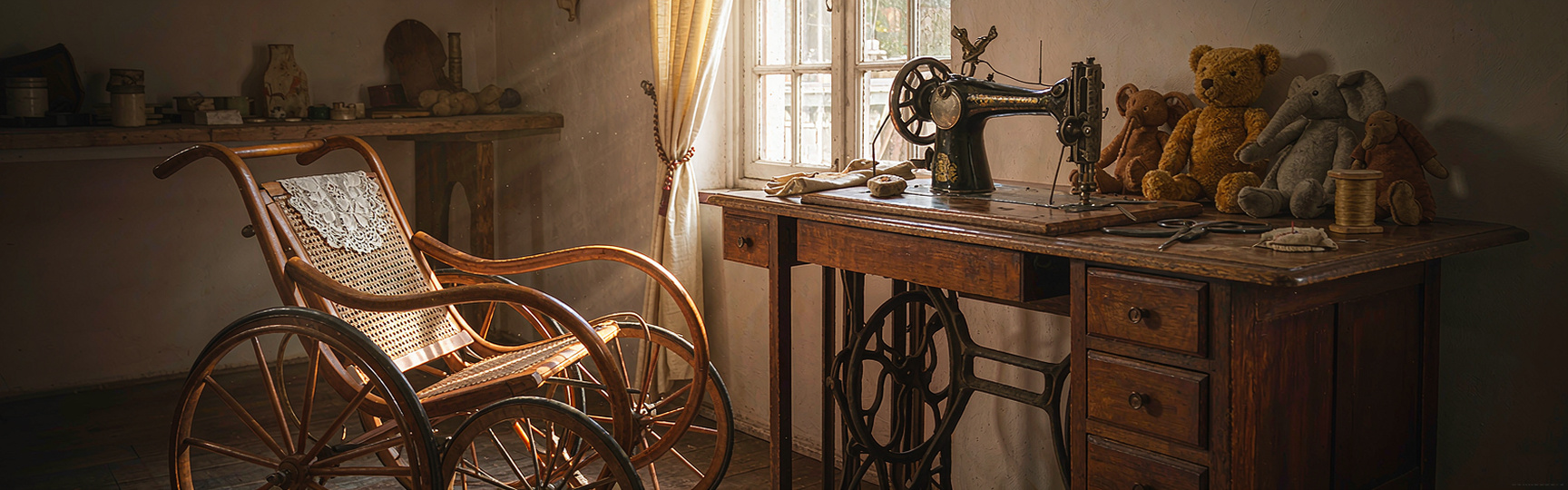
The Seamstress Who Built an Empire from a Wheelchair: What Margarete Steiff Teaches Us About Innovation, Resilience, and the Right Equipment
A shorter version of this title for SEO purposes: Margarete Steiff and the Power of the Right Equipment — then use the full line above as your H1/subhead combination.
In the 19th century, a woman in a wheelchair was expected to live a quiet, dependent life. Margarete Steiff did the exact opposite. Left paralyzed by polio at 18 months, with severely limited use of her right arm, she became one of Germany’s most successful entrepreneurs — building a company that produced the bear widely credited as the world’s first jointed plush teddy bear, and grew into a global toy brand that still carries her name today.
One moment captures the turning point. In 1903, at the Leipzig toy fair, an American buyer came across Richard Steiff’s new plush bear, hesitated over the shaggy, awkward-looking animal — and then bought the entire collection outright. Within a few years the "Teddy bear" was a phenomenon. Behind that moment stood decades of unglamorous work by a woman who could not walk and could barely use her right hand.
This is what modern garment makers and manufacturers can learn from Steiff’s journey — and how the same principles of adaptation and reliability apply to today’s industrial sewing technology.
1. Who Was Margarete Steiff? The Seamstress Who Defied Every Expectation
Born in Giengen an der Brenz, Germany, in 1847, Margarete contracted polio at just 18 months old. The illness left both legs paralyzed and her right arm painful and weak, confining her to a wheelchair for life. In an era when disabled women were expected to depend on others, she fought for an education, learned to sew against considerable physical difficulty, and was running her own business by 30.
Key milestones in her journey
|
Year |
Milestone |
|
1860s |
Completed her seamstress apprenticeship at 17, despite limited use of her right hand |
|
1874 |
Her father converted the family house to give her a dedicated workroom |
|
1877 |
Founded her own felt clothing business, selling self-made garments and household items |
|
1879–1880 |
Spotted a small elephant pattern in a fashion magazine and sewed it as a pincushion — the "Elefäntle" became a bestseller |
|
1893 |
Registered her business in the commercial register as a felt toy factory |
|
1902 |
Her nephew Richard designed the "Bear 55 PB" — jointed, movable arms and legs |
|
1904 |
Introduced the "Button in Ear" trademark to protect her products from imitation |
What makes the record remarkable is not any single invention. It is that every one of these steps was taken by someone the world had already written off. Her own motto, printed in the company’s first illustrated catalogue, was simple: "For children, only the best is good enough."
2. How Did She Adapt Her Sewing Machine to Work for Her?
Standard sewing was nearly impossible for Margarete: her right hand could barely turn the flywheel. Her solution was not to wait for better technology — it was to change the technology she had.
She bought what was reportedly the first sewing machine in Giengen, Germany. Because she could not work the flywheel from the right-hand side, and because the front of the machine was hard to reach from a wheelchair, she turned the machine around and operated it from the back, driving it with her stronger left hand.
Why this moment matters more than it looks:
- She acquired the tool first, then reshaped it around her own constraints
- Rather than accepting the machine’s limitations, she reconfigured the setup to match her abilities
- That single act of adaptation is the same problem-solving instinct that later produced a product line, a factory, and a global brand
What this teaches modern manufacturers: The right equipment isn’t about owning the newest technology — it’s about owning technology that adapts to your needs. Steiff’s modified machine was not cutting-edge even by 19th-century standards. It was simply configured so that it worked for the person using it. That is what made it productive.
3. What Can Modern Garment Factories Learn from Steiff’s Approach?
Steiff’s story is more than personal triumph. Read properly, it is a compact case study in manufacturing discipline.
|
Steiff’s principle |
Modern application |
|
Adapt equipment to the task, not the reverse |
Specify machines that match your actual production requirements, not the newest model on the market |
|
Start with one reliable tool |
Build around a dependable lockstitch machine before investing in specialized automation |
|
Scale incrementally |
She worked with a handful of seamstresses and home workers long before she had a factory — capacity followed demand, not the reverse |
|
Let quality create demand |
The felt elephants sold because of how well they were made, before there was meaningful marketing behind them |
|
Innovate from a solid core |
The teddy bear came from Richard Steiff’s design, but it could only succeed on top of Margarete’s foundation of consistent, reliable sewing |
The takeaway: Innovation doesn’t require starting from scratch. It requires a solid foundation, the right tools, and the willingness to adapt them.
4. What Does Modern Industrial Sewing Equipment Offer Today’s Manufacturers?
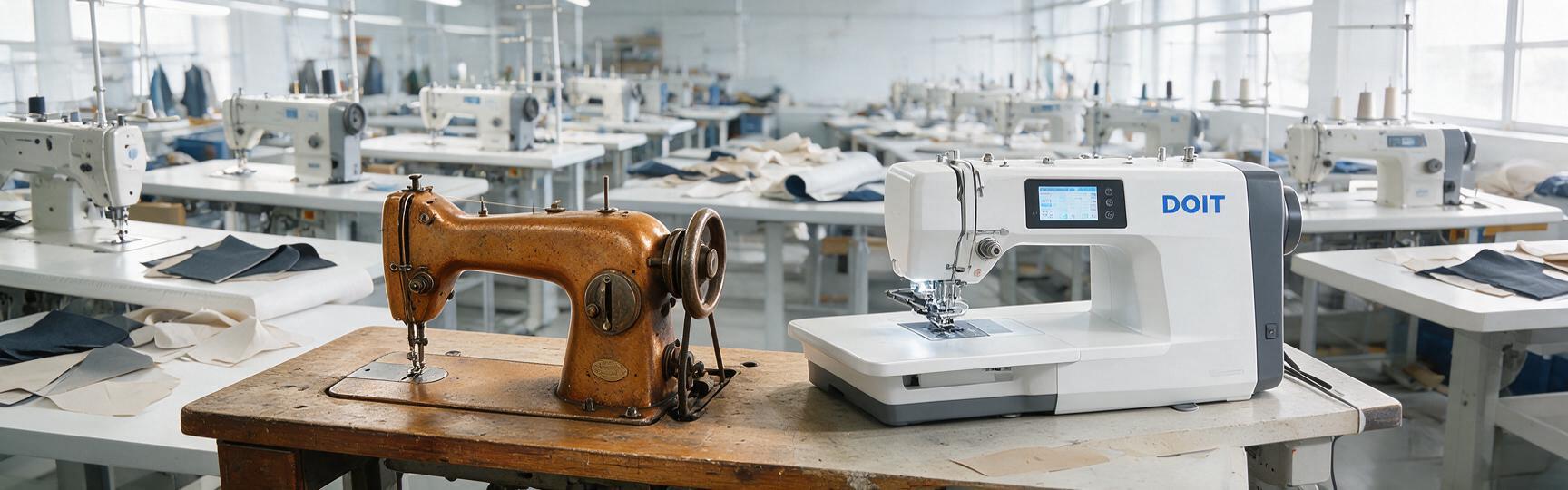
Where Steiff started with one manually adapted machine, today’s manufacturers can draw on equipment engineered specifically for precision, speed, and repeatability.
|
Era |
Technology |
Speed |
Capabilities |
|
1870s (Steiff’s era) |
Manual treadle machine |
Roughly 200–300 spm depending on the operator |
Straight stitch only |
|
1900s–1950s |
Electric clutch motor |
Up to roughly 1,000 spm |
Straight stitch, limited zigzag |
|
1960s–1990s |
High-speed industrial machines |
3,000–5,000 spm |
Multiple stitch types, auto-lubrication |
|
Today (DOIT) |
Direct-drive servo with stepper control |
5,000+ spm |
Computerized control, auto-trimmer, pattern storage |
The parallel is not the speed. It is that the tool should remove friction from the operator rather than add to it. In Steiff’s case that meant turning a machine around. Today it means direct-drive servo motors that reduce vibration and fatigue, automated functions that cut repetitive motion, and controls that shorten training time for new operators.
5. Which DOIT Machines Fit Modern Garment Production?
DOIT Group manufactures a broad range of industrial sewing machines covering garment production from basic construction through specialized operations.
Lockstitch machines
|
Model |
Key specifications |
Best for |
|
DT C10-D4 |
Direct drive, stepper motor, 5,000 spm, 550 W, LCD interface |
Precision garment construction |
|
DT C9 |
Direct drive, stepper motor, 5,000 spm; handles quilting up to 15 mm; 10 built-in stitch patterns |
Medium and thick fabrics, woven and knitted |
|
DT H10-D4 |
Direct-drive computerized lockstitch with synchronized top and bottom feed |
Heavy-duty materials without layer shift |
|
DT 1510N |
Single-needle compound-feed heavy-duty lockstitch |
Thick, multi-layer materials |
Overlock machines
|
Model |
Key specifications |
Best for |
|
DT 900-4AT |
Direct drive, 3/4/5-thread convertible, auto trimmer, stepper motor |
T-shirts, shirts, jeans, trousers, knitwear |
|
DT 940-4AT |
Direct drive, 4-thread, auto trimmer, up to 7,000 spm |
Professional edge finishing at volume |
Specialty machines
|
Model |
Application |
|
DT 3020TD-WY |
Automatic kangaroo pocket setter for jeans |
|
DT 254 |
Belt loop machine — uniform strength and durability |
|
DT 165-02 |
Placket machine — smooth, flat finish |
|
DT 63900 |
Computerized trouser bottom hemming |
Engineering common to the range
- All-metal construction on the main frames, built for continuous production use
- Direct-drive servo motors, which typically draw substantially less energy than conventional clutch motors while giving quieter, more controllable operation
- Readily available needle and parts systems — including 135×17 (DP×17) on the lockstitch models. Different machine types use different needle systems; always confirm against your model’s manual.
- 1-year warranty on machine parts, 2-year warranty on the motor
- ISO 9001 quality certification, with CE compliance
6. How Do Steiff’s Quality Standards Apply to Modern Manufacturing?
Steiff’s company became a global name not through marketing genius but through uncompromising quality. The "Button in Ear" trademark, introduced in 1904, existed to protect Steiff animals from imitation — a tacit acknowledgment that quality creates demand, and that imitation follows success.
Three principles carry over directly to the factory floor:
Consistent stitch quality. Every Steiff elephant, horse, and bear had to meet the same standard, whether it was the tenth or the ten-thousandth. Well-maintained industrial machines deliver that same repeatability across production runs — provided daily and periodic servicing actually happens.
Durability. Steiff’s toys were built to survive generations of handling. Industrial equipment should be judged the same way: not by features listed on a spec sheet, but by how many shifts it runs without intervention.
Innovation resting on reliability. The teddy bear was revolutionary because it sat on top of a manufacturing process that already worked. New product ideas are only viable when the equipment underneath them is dependable.
The commercial logic is straightforward: factories that invest in equipment quality and maintenance consistently report lower defect rates and less rework than those that buy on price alone. Reliable machines don’t just produce better garments — they produce more profitable ones.
7. What Are the Most Important Lessons for Today’s Garment Manufacturers?
Lesson 1 — The right equipment adapts to you, not the other way around. Steiff turned her machine around rather than working around it. Choose equipment that matches your production needs: a DT C10-D4 for precision construction, a DT H10-D4 where layers must not shift, a DT 1510N when thick seams are routine.
Lesson 2 — Start simple, scale intelligently. She worked with a small team of seamstresses and home workers before commissioning a purpose-built factory. Modern lines work the same way: establish a core lockstitch platform first, then add overlock and specialty machines as volume justifies them.
Lesson 3 — Quality creates its own demand. The felt elephants sold because they were better made than the porcelain, wood, and tin toys of the period. Consistent quality remains the cheapest customer-retention strategy available to a factory.
Lesson 4 — Innovation comes from iteration. The first elephant was a pincushion. Children turned it into a toy. Richard Steiff designed the bear. None of it was a single breakthrough — it was a sequence of incremental improvements on a working foundation.
Lesson 5 — Reliability is the ultimate productivity tool. Steiff could not afford equipment that failed, and neither can a factory running to a delivery date. All-metal construction, direct-drive servo motors, and standardized parts are today’s equivalent of a machine that simply works — shift after shift, year after year.
8. How Does DOIT Group Support the Next Generation of Manufacturers?
Behind every garment there is a story — a one-person workshop adapting around a constraint, or a factory producing thousands of pieces a day. DOIT Group has spent more than 15 years producing and exporting garment equipment, covering lockstitch, interlock, overlock, and special sewing machines.
What that translates to for a buyer
- Direct manufacturer pricing — industrial-grade equipment without distributor markup
- Machines designed to shorten training — straightforward controls and features that reduce operator learning time
- Built for continuous service — metal construction and standardized parts for long-term reliability
- Support after the sale — 1-year warranty on machine parts, 2-year warranty on the motor, and lifetime after-sales assistance
- Versatility where it matters — machines configured to handle more than one operation, so manufacturers can adapt as market demand shifts
For reference on day-to-day upkeep once a machine is on your floor, see our industrial sewing machine maintenance guide.
9. What Does Margarete Steiff’s Story Mean for You?
Steiff’s journey from a wheelchair in a small German town to the head of a global company is not just an inspiring anecdote. It is a practical blueprint for anyone who refuses to accept a limitation as permanent.
Key takeaways
- Your circumstances don’t define your potential. Steiff’s disability became the catalyst for her way of working, not a barrier to it.
- The right tool changes everything. Her reconfigured machine made her independent. That principle holds whether you run one machine or one hundred.
- Quality is the foundation of lasting success. Steiff’s products were loved because they were made well. Consistent production earns the same loyalty today.
- Start where you are, use what you have. She began with one machine and one pattern. Large businesses usually start as small, persistent ones.
The modern parallel: A manufacturer who buys a dependable machine today — a DT C10-D4 for precision work, say — is making the same decision Steiff made in the 1870s, when she put her own money into the machine that let her work. Not the purchase of a business. The purchase of the capability that makes the business possible.
10. The Bottom Line: Build Something That Lasts
Margarete Steiff built a company that outlived two world wars, repeated economic crises, and more than a century of changing taste. That durability was not luck. It came from quality, adaptability, and a refusal to accept limitations on someone else’s terms.
For today’s manufacturers, the lesson is clear:
- Choose equipment that matches your actual needs
- Prioritize reliability over impressive-looking features
- Build quality into every stitch
- Adapt to your circumstances rather than letting them define you
DOIT Group manufactures industrial sewing machines built for the demands of modern production — with the same commitment to durable construction and dependable output that Margarete Steiff demanded of the first tool she ever owned.
From a wheelchair in 19th-century Germany to a company that outlasted her by more than a century: great things get built one stitch at a time.
Ready to build your own manufacturing story on reliable industrial sewing machines? Explore DOIT Group’s full range at doitsewingmachine.com.
📩 Email: sales6@chinadoit.cn
🌐 Website: doitsewingmachine.com
From "Feet Zipper" to Real Innovation: What Your Creative Ideas Really Need to Come to Life