From 40-Year Legacy to Modern Powerhouse: How to Save a Family Manufacturing Business
From 40-Year Legacy to Modern Powerhouse: How to Save a Family Manufacturing Business
A recent Reddit post in r/smallbusinessowner struck a nerve: a son shared that his father's 40-year-old manufacturing business is "falling apart." The father is aging, the equipment is outdated, and the son is watching his family's legacy slip away. The comments poured in, filled with empathy and hard-earned advice from others who have faced the same crossroads. One theme echoed throughout: the emotional weight of modernizing a parent's life work is immense, but doing nothing is not an option.
This guide is for every son or daughter who has stepped into a family business and found it stuck in the past. It's about honoring the legacy while building for the future — and why upgrading to modern industrial equipment isn't a betrayal of your father's work, but the only way to save it.
1. The Hidden Cost of "It Still Works"
Family businesses often operate on a simple principle: if it isn't broken, don't fix it. But "still works" is not the same as "still competitive."
What outdated equipment actually costs:
| Hidden Cost | Impact on the Business |
|---|---|
| Downtime | Unplanned breakdowns halt production and delay orders |
| Rework | Inconsistent quality leads to rejected products and wasted materials |
| Energy waste | Old clutch motors consume up to 70% more electricity than modern servo motors |
| Skilled labor dependency | Old machines require experienced operators who are increasingly hard to find |
| Maintenance drain | Aging parts are expensive and difficult to source |
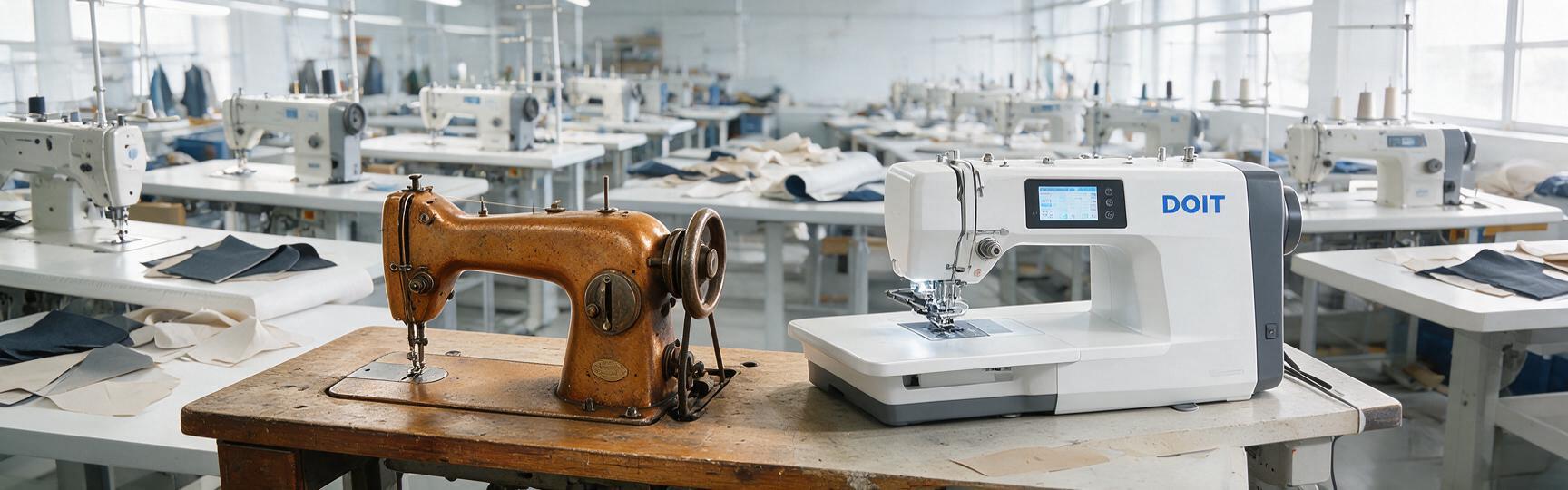
The Reddit poster's father built something that lasted 40 years. But in today's market, a machine that was top-of-the-line in 1985 is a liability in 2026. The business isn't falling apart because of bad management — it's falling apart because the tools haven't kept pace with the times.
2. Why Equipment Modernization Is the First Step, Not the Last
When a family business is struggling, the instinct is to cut costs everywhere. But cutting equipment investment is a false economy.
The modernization ROI:
-
Replacing old clutch motors with direct-drive servo motors saves 60–70% on energy costs, with payback periods as short as 7 months
-
Modern lockstitch machines operate at 5,000 stitches per minute compared to 1,000–2,000 on aging equipment — a 2.5x to 5x productivity gain
-
Automated features (auto-trimmer, auto-backtack, auto presser foot lift) reduce operator fatigue and allow semi-skilled workers to achieve professional results
The Reddit community's advice was clear: "You can't save a business by preserving the past. You have to invest in the future."
3. What Modern Industrial Sewing Machines Offer That Old Ones Can't
If you're stepping into a family business and the machines are decades old, here's what you're missing:
Technology built for today's production demands:
| Feature | Old Machines (1980s–1990s) | Modern DOIT Machines |
|---|---|---|
| Motor | Clutch motor, runs constantly | Direct-drive servo, uses power only when sewing |
| Speed | 1,500–2,500 SPM | 5,000 SPM |
| Stitch Quality | Inconsistent, operator-dependent | Computer-controlled, precise |
| Auto Functions | None | Auto-trimmer, auto-backtack, auto presser foot lift |
| Maintenance | Frequent, complex | Low-maintenance, standardized parts |
| Fabric Capacity | Limited to light-medium | Handles thin to heavy (up to 16mm) |
The DOIT advantage: DOIT Group's industrial sewing machines are engineered for the demands of modern garment production. The DT C10-D4 Direct Drive Computerized Lockstitch with Stepper Motor features a 550W high-efficiency motor (noise ≤ 60dB), automatic thread trimming, automatic backstitching, and automatic presser foot lifting — all controlled by an intuitive LCD display. It's designed for "mass production in small and large processing plants, tailor shops, and home DIY projects — one machine for multiple uses".
4. How to Approach Your Father About Modernizing
This is the hardest part. A 40-year-old business isn't just equipment — it's your father's life work. Approaching him with a list of everything that's wrong will only create resistance.
A better approach:
-
Frame it as growth, not replacement. "Dad, your machines built this business. Now let's give them the support they need to take it to the next level."
-
Show him the numbers. Energy savings, productivity gains, and faster delivery times speak louder than any argument.
-
Start with one machine. Propose upgrading a single workstation as a pilot project. Let the results speak for themselves.
-
Involve him in the decision. Ask his opinion on which operations would benefit most. His experience is invaluable — you just need to pair it with modern tools.
The Reddit consensus: "Respect the past, but don't let it hold you hostage. Your father wants the business to survive — he just needs to see that modernization is the path to survival."
5. Key Machines for Different Production Lines
Every family business has its own specialty. Here's how DOIT machines support different production needs:
| Production Focus | Recommended DOIT Machine | Why It Fits |
|---|---|---|
| General garment construction | DT C10-D4 | 5,000 SPM, handles thin to heavy fabrics, auto-trimmer and auto-backtack reduce labor |
| Denim and heavy fabrics | DT H10-D4 | Synchronous top and bottom feed, stepper motor control, handles up to 13mm thickness |
| Waistband and elastic | DT 1508P-D | 4-needle double chain stitch with puller, 3,800 RPM, specialized for waistband stitching |
| Long-arm work (bags, upholstery) | DT 4420HL-18 | Long arm compound feed, handles 8–16mm thickness, 2,200 RPM |
| Button attaching | DT 808D | Heavy-duty button attach, 4,000 SPM, suitable for production workshops |
6. The Financial Case: How to Fund the Upgrade
Modernization doesn't require draining the family savings. Several financing options exist:
| Financing Option | Best For | Key Benefit |
|---|---|---|
| Equipment loans | Purchasing new machines | Preserves cash flow with monthly payments |
| SBA loans | Small businesses in the US | Longer terms, lower rates |
| Equipment lines of credit | Ongoing upgrades | Flexible, use as needed |
| Leasing | Preserving capital | Lower upfront cost, tax benefits |
| Trade-in programs | Replacing old equipment | Offset the cost of new machines |
The ROI timeline: A single machine upgrade can pay for itself in 7 months to 2.5 years through energy savings alone. Add productivity gains and reduced rework, and the payback is even faster.
7. The Maintenance Advantage: Less Downtime, More Production
Old machines break down. It's not a question of if, but when. Modern machines are built to run — and when they do need service, parts are readily available.
What modern machines offer:
-
Preventive maintenance is simple: Daily cleaning and oiling take minutes, not hours
-
Parts are standardized: The 135×17 needle system is industry-standard, available everywhere
-
Warranty protection: DOIT offers a 1-year warranty on machine parts and a 2-year warranty on the motor, with lifetime after-sales support
-
Technical support: Online assistance and local service options minimize downtime when issues arise
The data: Factories that replace aging equipment with modern, reliable machinery report "a stronger foundation for growth while continuing to provide the high-quality workmanship its customers value".
8. Why DOIT Group Is the Right Partner for Family Businesses
DOIT Group understands the needs of family-run manufacturing businesses. With over 15 years of expertise in producing and exporting garment equipment, DOIT specializes in a comprehensive range of machines including lockstitch, interlock, overlock, and special sewing machines.
Why DOIT fits family businesses:
-
Affordable without compromising quality: Direct manufacturer pricing means you get industrial-grade machines at competitive prices
-
Easy to operate: Modern DOIT machines are designed with "easy to operate" features that "no professional training required" — ideal for businesses transitioning from aging equipment
-
Built to last: All-metal construction and industrial-grade materials ensure your investment will serve the next generation, not just the next year
-
Support that matters: ISO9001 quality certification, CE and ISO compliance, and a responsive technical team
The DOIT promise: "One machine for multiple uses" — versatility that helps family businesses adapt to changing market demands without buying a different machine for every product type.
9. A Step-by-Step Modernization Roadmap
You don't have to upgrade everything at once. Here's a phased approach that respects both your budget and your father's legacy:
| Phase | Timeline | Action | Expected Result |
|---|---|---|---|
| Phase 1: Assessment | Weeks 1–2 | Audit current equipment, identify highest-impact upgrades | Clear priority list |
| Phase 2: Pilot Upgrade | Weeks 3–8 | Replace one critical machine (e.g., lockstitch) | Immediate productivity gain, proof of concept |
| Phase 3: Energy Upgrade | Months 3–6 | Retrofit remaining machines with servo motors | 60–70% energy savings across the floor |
| Phase 4: Full Modernization | Months 6–12 | Replace remaining aging equipment with DOIT machines | Full production capacity, reduced downtime |
| Phase 5: Optimization | Months 12–24 | Train operators on new features, refine workflows | Maximum efficiency, next-generation readiness |
10. The Bottom Line: Honor the Past, Build the Future
The Reddit poster's father built something remarkable — a business that lasted 40 years. That's a legacy worth preserving. But preservation doesn't mean standing still. It means giving that legacy the tools it needs to survive and thrive in a new era.
Key takeaways:
-
"Still works" is not a strategy. Old equipment silently drains profit through downtime, rework, and energy waste.
-
Modernization is an investment, not an expense. Servo motors pay for themselves in 7 months to 2.5 years.
-
Approach your father with respect. Frame upgrades as growth, not replacement.
-
Start small, scale up. A single machine upgrade proves the concept and builds confidence.
-
Choose a partner who understands family businesses. DOIT Group offers affordable, reliable, easy-to-operate machines with the support you need.
Your father's 40-year legacy deserves a future. Modernizing the equipment isn't about leaving the past behind — it's about giving it the power to keep going.
Ready to start your family business modernization journey? Explore DOIT Group's full range of industrial sewing machines at doitsewingmachine.com.
📩 Email: sales6@chinadoit.cn
🌐 Website: doitsewingmachine.com
From Frustrating Outsourcing to In-House Control: Why Quilters Are Turning to Industrial Machines