From Fabric Map to Finished Garment: What Happens When a Home Studio Outgrows Its Sewing Machine
From Fabric Map to Finished Garment: What Happens When a Home Studio Outgrows Its Sewing Machine
1. The Map, and Why It Exists
Somewhere on Reddit right now, someone is maintaining a spreadsheet of fabric shops so that other people don’t have to drive an hour to find out a store closed.
The best-known version of this is the r/sewing Fabric Shop Map — a Google Maps layer built and maintained by the r/sewing moderator team, open to submissions from anyone, and permanently listed in the subreddit’s own resource sidebar. In a March 2026 moderator update, the team reported that after Joann’s closure drove a surge of submissions, they had worked through more than 4,000 entries to confirm just under 1,500 stores on the map. It is explicitly described as a work in progress that depends on the community to stay accurate.
Two things are worth noticing.
First, the scale of the community. r/sewing has roughly 2.2 million members. This is not a niche.
Second, and more important: the map was built in response to a loss, not a boom. Joann, the US big-box fabric chain, closed its stores in 2025. For a lot of American sewists that meant the nearest fabric shop went from ten minutes away to an hour away — and for some, to nothing at all. The map is a piece of infrastructure built by people who lost access, so that the next person doesn’t have to lose it too.
That is a better story than "the maker economy is booming," and it is the true one.
Sources: r/sewing moderator announcement (Fabric Shop Map update, March 2026); r/sewing community resource sidebar; Forbes, Joann is closing for good (March 2025).
2. What the Market Data Actually Says
Home sewing is a real, growing category — but the numbers are softer than they look.
One market estimate (VPAResearch, H2 2026) puts the global home sewing machine market at 3.0 billion in 2026**, growing to **3.9 billion by 2032 at a 4.3% CAGR. We cite the firm by name because the estimates disagree substantially: other research houses put the 2026 market anywhere between $2.38 billion and $5.84 billion, depending on whether they count embroidery machines, quilting frames, and light-commercial units.
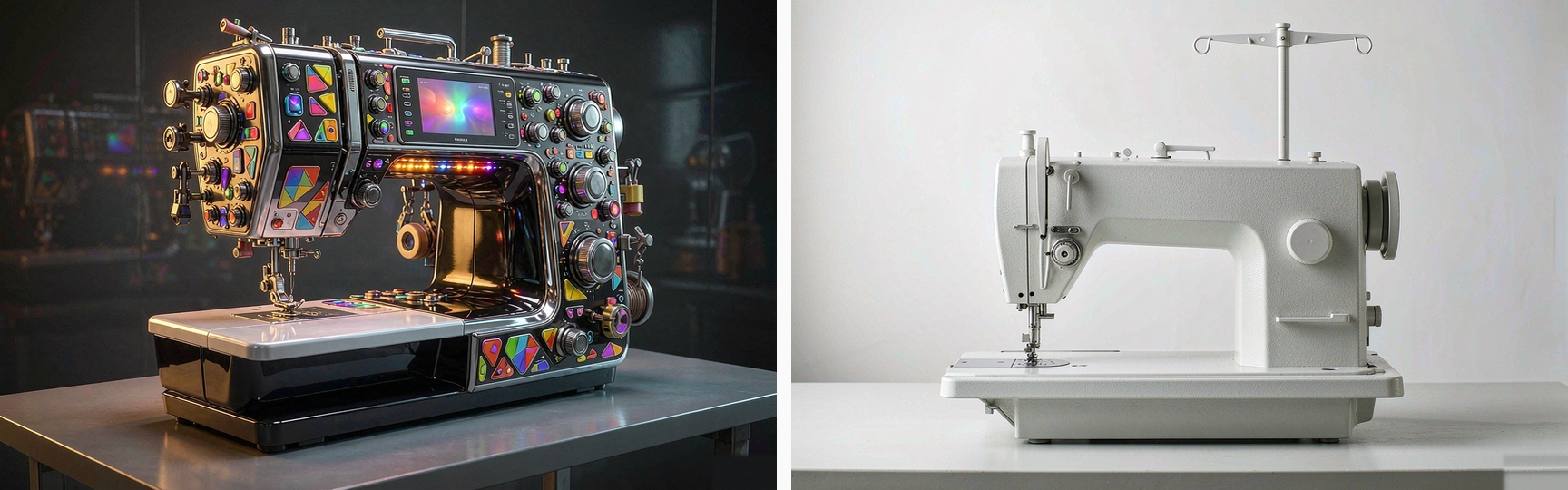
What all of them agree on is the direction of travel: demand is driven by repair and alteration, upcycling, and — the part that matters here — small-scale entrepreneurship run from domestic workspaces. Manufacturers are responding: Singer now markets domestic machines rated to 1,100 stitches per minute with reinforced piercing power specifically for denim and canvas; Juki and Brother are pushing computerised domestic machines with automatic thread trimming and cloud-connected design transfer.
Which brings us to the actual question in this article.
3. Where a Home Studio Hits a Wall
The honest version of this is narrower than most equipment marketing admits.
A good domestic machine can sew denim. Heavy-duty home machines exist precisely for denim, canvas, and multilayer work, and they do it fine for single garments. If you are making one jacket, you probably do not need an industrial machine.
What breaks down is not capability — it is volume, consistency, and duty cycle. Three specific failure modes:
Duty cycle. A domestic machine is designed for intermittent use: a few hours, then it rests. Run one eight hours a day and you will find the limits of its motor, its bobbin capacity, and your patience with it. An industrial head is built to run a full shift.
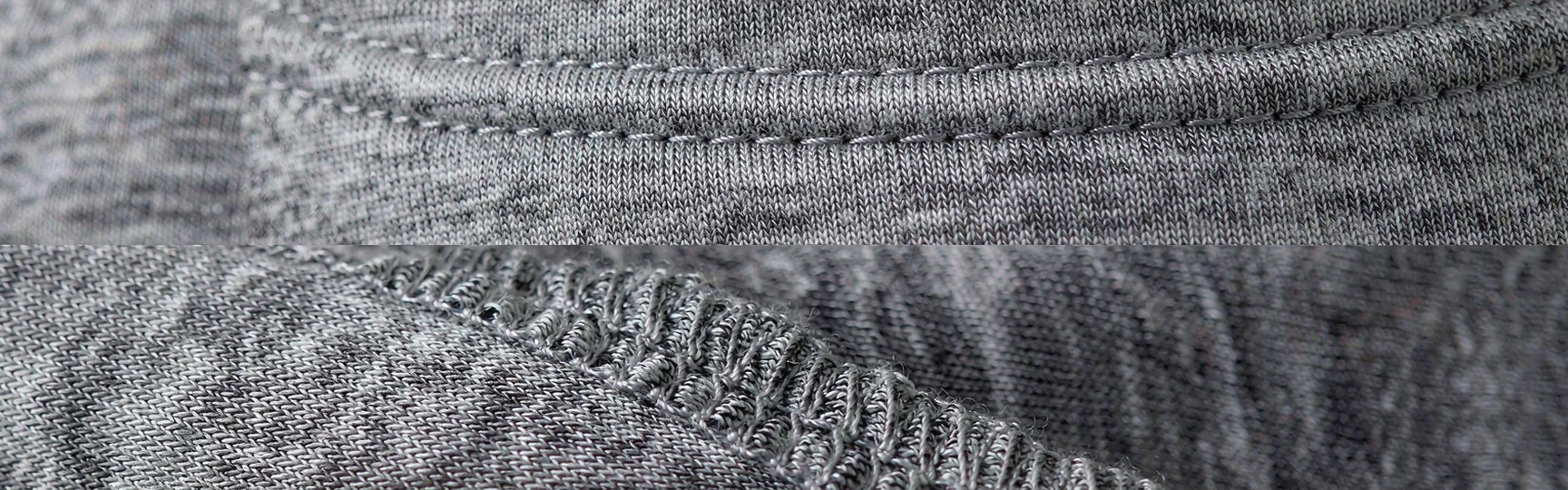
Consistency at thickness transitions. Crossing a flat-felled seam on 14 oz denim is where domestic machines struggle — not because they cannot pierce it, but because feed and penetration become uneven at that point, and uneven feed shows up as puckering and skipped stitches. A compound-feed or top-and-bottom-feed industrial head handles transitions that a domestic drop-feed machine does not.
Single-function specialisation. This is the real difference, and it is usually left out. An industrial machine does one thing, extremely well, all day. A domestic machine does forty things adequately. Once you are making the same pocket 200 times, "one thing extremely well" wins.
And one more, in fairness to the domestic machine: industrial machines are faster than most people can control. 5,000 stitches per minute is not a benefit to someone who has spent two years sewing at 800. Speed is a skill, not a spec.
4. What Nobody Tells You Before You Buy an Industrial Machine
If you are reading this from a spare room, read this section twice.
- It needs a table. Industrial heads ship mounted in a stand with a knee-lift and a separate motor. That is roughly a metre and a half of dedicated floor space, permanently.
- It oil itself, and oil gets on things. Industrial machines are oil-lubricated with a reservoir. Domestic machines are not. If your workspace is also your living space, this matters.
- It does one stitch type. A lockstitch machine sews a straight line. That is all. Overlock, coverstitch, buttonholes, and pocket setting are separate machines.
- Check your power. Most modern direct-drive servo heads will run on single-phase domestic supply, but older clutch-motor machines commonly require three-phase. Confirm before you order.
- It is loud. Not "noticeable" — loud, in a way a domestic machine is not.
- Servicing is different. Industrial machines are serviced, not replaced. You need a technician who knows the machine, or you need to learn.
None of this makes them the wrong choice. It means the decision is about your production, not about your ambition.
5. When the Numbers Actually Work
Here is the arithmetic you should run, with your own numbers in it:
Fill that in before you spend anything. A generic claim like "a $1,200 machine generates $10,000 in additional revenue" is not a calculation — it has no piece count, no time saving, and it counts revenue rather than profit. If a piece takes 40 minutes on your current machine and 25 minutes on an industrial one, and you make 20 pieces a week at a 15 hourly cost, the machine returns roughly **3,900 a year** and pays for itself in about four months. If you make four pieces a week, it returns about $780, and payback stretches past eighteen months. Both are real answers, and only you know which one you are.
Where the second machine usually earns its place first is not speed but a capability you cannot do at all — a clean overlocked edge, a coverstitched hem, a set pocket. Buy the capability gap before you buy the speed gap.
6. DOIT Group’s Machines, by What They Actually Solve
DOIT Group manufactures industrial sewing machines — lockstitch, overlock, interlock, and special-purpose units — for continuous production.
General construction:
|
Machine |
What it is |
Where it fits |
|
DT C10-D4 |
Direct-drive computerised lockstitch with stepper motor |
First industrial machine for most small studios: auto back-tack, programmable stitch counts, needle positioning |
|
DT C11 |
Direct-drive computerised lockstitch, high-speed |
Higher-volume general construction |
Heavy fabric and denim:
|
Machine |
What it is |
Where it fits |
|
DT H10-D4 |
Direct-drive computerised top-and-bottom feed lockstitch |
Thickness transitions and multilayer denim — the failure mode described in section 3 |
|
DT 1510N |
Single-needle compound feed heavy-duty lockstitch |
Heavy assemblies, canvas, leather work |
Edge finishing and knits:
|
Machine |
What it is |
Where it fits |
|
DT 5114EXT |
4-thread cylinder bed, top-and-bottom feed overlock |
The capability gap most home studios hit first |
|
DT 900-4AT |
Direct-drive 4-thread overlock with electronic auto trimmer |
Fast, clean edge finishing at volume |
Specialty operations:
|
Machine |
What it is |
Where it fits |
|
DT 3020TD-WY |
Automatic pocket setter |
Once pockets are your bottleneck |
|
DT 9407 |
Automatic darts and waistband pleats |
Repetitive shaped operations |
|
DT 886B |
Automatic laser pocket welting |
Tailored and trouser production |
What sits behind the running cost:
- Direct-drive servo motors draw power only when the pedal is pressed, with roughly 1 W on standby. Against an industrial clutch motor, published field figures put the saving at 60–70% — that is an industrial-to-industrial comparison, not a domestic-to-industrial one.
- All-metal construction for continuous-shift durability
- Automatic lubrication, which removes the most frequent routine service task
- 135×17 (DP×17) needle system on DOIT lockstitch machines — the most widely stocked industrial needle system, so consumables are easy to source locally. (Overlock and specialty heads use their own needle systems; confirm per model.)
- ISO 9001 certified manufacturing, with CE marking on applicable models
- 1-year warranty on machine parts, 2-year warranty on the motor
- Lifetime after-sales support
7. The Community Part, Stated Honestly
The Fabric Shop Map works because thousands of people each contributed one thing they knew, and one person — actually, a small team — did the unglamorous work of checking and maintaining it.
That is also what a supplier is supposed to do, and it is worth being precise about the difference. A community project is free and non-commercial. A manufacturer is not, and pretending otherwise helps nobody. What a manufacturer can honestly offer is narrower and more useful: say what the machine will and will not do, tell you when you don’t need it yet, and still be reachable in three years when something breaks.
So, concretely:
- If you sew for yourself, you probably do not need an industrial machine. Buy better fabric. Use the map.
- If you sell occasionally — under roughly 20–30 pieces a week — a good heavy-duty domestic machine is usually the right answer, and a specialist service can handle the operations you can’t do. Run the section 5 arithmetic before you disagree with this.
- If you are consistently above that, or you have hit a capability you cannot do at all, that is the moment to price an industrial machine. Run the arithmetic in section 5 with your own numbers first.
8. The Bottom Line
The Fabric Shop Map is a genuine piece of community infrastructure: roughly 1,500 stores, curated from more than 4,000 submissions, maintained by volunteers because a national chain closed and left people without anywhere to buy fabric.
- The community is large and serious — r/sewing alone is around 2.2 million people
- The home sewing market is real — one estimate puts it at $3.0 billion in 2026, though published estimates range from $2.4 billion to $5.8 billion depending on scope
- Domestic machines are more capable than the marketing suggests — heavy-duty home machines do denim; the gap is duty cycle, consistency at thickness, and single-function specialisation
- Industrial machines have real prerequisites — space, oil, noise, power, and one-function-per-machine
- Buy the capability gap before the speed gap
If you are at the point where the arithmetic in section 5 works out, DOIT Group builds industrial sewing machines for every stage of that transition — lockstitch, overlock, interlock, and special-purpose units, with ISO 9001 certified manufacturing and CE marking on applicable models.
Not sure which stage you are at? Send us your weekly piece count, fabric weights, and the operations you currently subcontract, and we will tell you what you actually need — including if the answer is "not yet."
📩 Email: sales6@chinadoit.cn 🌐 Website: doitsewingmachine.com
Overrated Sewing Machine Features: What Actually Matters